
⚡ Quick Answer
A non-programmable thermostat — also called a manual thermostat — is the simplest type of HVAC controller. It lets you manually set a single temperature and turn your heating or cooling on and off. There are no schedules, no apps, and no automatic adjustments. Every temperature change must be made by hand. It is the most affordable and straightforward thermostat available — and still used in 36% of U.S. homes today.
Non-Programmable vs Programmable vs Smart: At a Glance
| Feature | Non-Programmable | Programmable | Smart |
|---|---|---|---|
| Average Price | $20–$50 | $50–$150 | $150–$300 |
| Scheduling | None — manual only | 7-day automatic | Auto-learning + app |
| Auto Energy Savings | 0% (manual only) | 8–10% | 12–23% |
| Remote App Control | No | Wi-Fi models only | Yes — full control |
| Learning Algorithm | No | No | Yes |
| Best For | Seniors, simple systems, tight budgets | Most homeowners | Tech users, irregular schedules |
🔑 5 Key Takeaways
- 36% of U.S. homes still use a manual non-programmable thermostat — making it the second most common type (EIA 2020)
- Non-programmable thermostats cost just $20–$50 — the most affordable thermostat option available
- They deliver zero automatic energy savings — but disciplined manual setbacks can still cut bills meaningfully
- They are ideal for seniors, renters, vacation homes, and anyone who values simplicity over automation
- Upgrading to a programmable thermostat saves 8–10% on heating and cooling bills — paying back in under 2 years for most households
What Is a Non-Programmable Thermostat?
The Simple Plain-English Definition
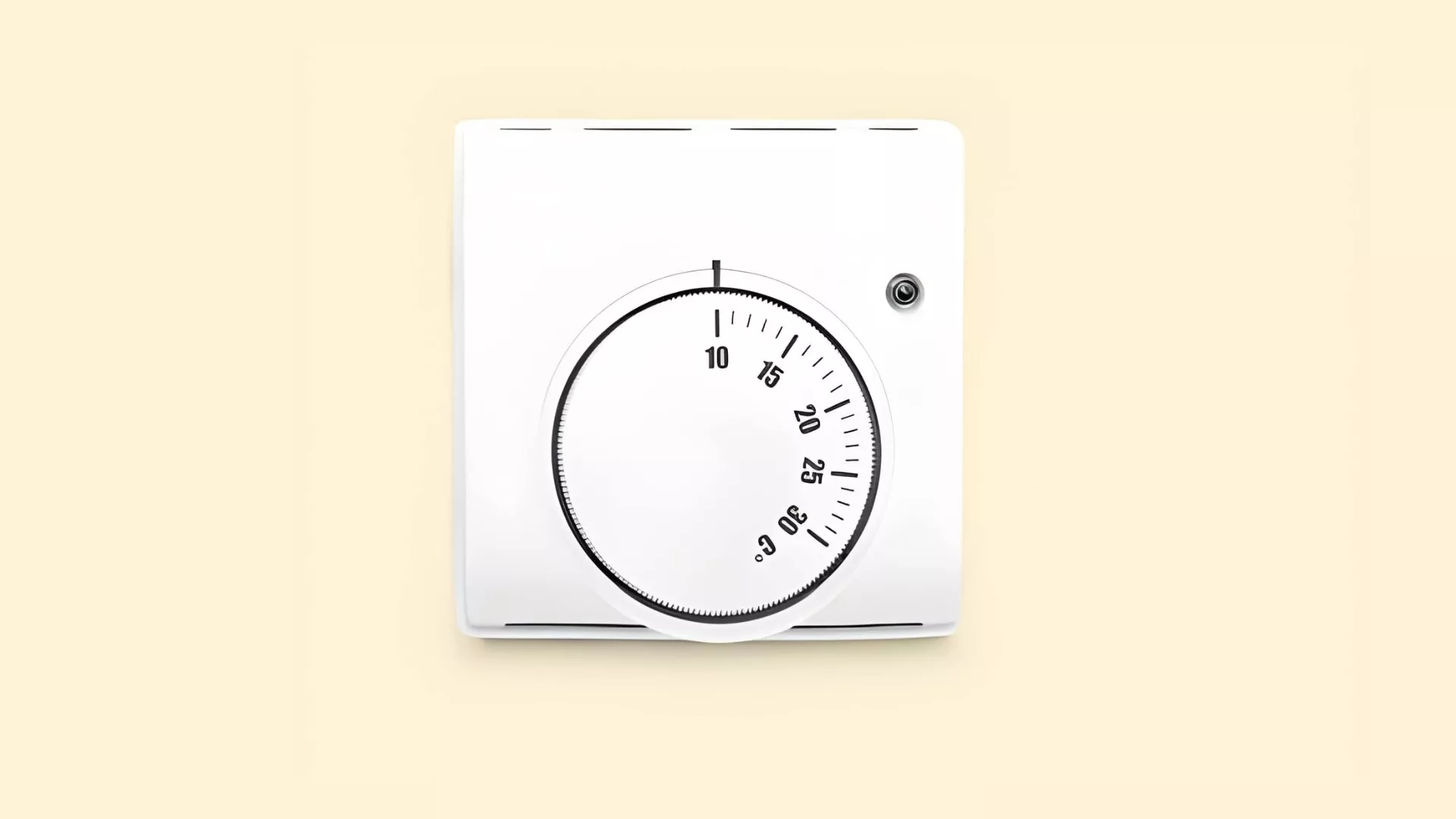
A non-programmable thermostat — also widely called a manual thermostat — is the most basic type of home temperature controller available. It does one job and does it simply: you set a temperature, and it keeps your HVAC system running until that temperature is reached. There are no built-in schedules, no timers, no Wi-Fi connection, and no smartphone app. Every single temperature adjustment must be made by hand — either by turning a dial or pressing a button directly on the device.
What It Can and Cannot Do
Understanding what a non-programmable thermostat can and cannot do helps set the right expectations before buying one:
- ✅ Can do: Set a single target temperature manually
- ✅ Can do: Turn your heating or cooling system on and off
- ✅ Can do: Control your HVAC fan (on or auto)
- ❌ Cannot do: Set automatic daily or weekly schedules
- ❌ Cannot do: Connect to Wi-Fi or a smartphone app
- ❌ Cannot do: Learn your routine or adjust automatically
Where You Most Commonly Find Them
Non-programmable thermostats are most commonly found in older homes, rental properties, vacation homes, and basic single-stage HVAC setups. They were the standard in American homes for decades before programmable models became affordable and widely available. According to the U.S. Energy Information Administration (EIA) 2020 Residential Energy Consumption Survey — the most detailed national survey available — 36% of U.S. households still use a manual or non-programmable thermostat. That is more than one in three homes, making it far more common than most people realise.
How Does a Non-Programmable Thermostat Work?
The Internal Temperature Sensor
Inside every non-programmable thermostat is a temperature sensor — either a simple bimetallic strip in older mechanical models or a small electronic thermistor in modern digital ones. This sensor continuously measures the air temperature in the room where the thermostat is installed. It compares that reading to the temperature you have manually set on the dial or display. This comparison happens constantly — and it is the core of how the device controls your HVAC system.
The Simple On/Off Signal
When the room temperature drifts away from your set point — either too cold in winter or too warm in summer — the thermostat sends a simple on/off electrical signal through your wiring to your furnace, air conditioner, or heat pump. For example, if you set the thermostat to 20°C (68°F) and the room drops to 18°C (64°F), the thermostat signals the furnace to turn on. Once the room reaches 20°C (68°F) again, it signals the system to turn off. This cycle repeats automatically — but only at the single temperature you have manually selected.
Dial vs Button vs Digital Display
Non-programmable thermostats come in three main interface styles — and each works slightly differently in terms of how you interact with it:
- 🔄 Dial (mechanical): You physically rotate a round dial to your desired temperature. A bimetallic coil inside expands or contracts with temperature changes to open or close the circuit.
- 🔘 Button (digital): You press up/down buttons to set your target temperature on a small digital display. An electronic thermistor reads room temperature and triggers the system.
- 👆 Basic touchscreen: You tap a simple display — no scheduling menus, just temperature up/down and mode selection.
All three work on the same fundamental principle. The only difference is the interface. There are no timers, no apps, and no learning algorithms — just a sensor, a set point, and an on/off signal to your HVAC system.
Non-Programmable vs Programmable Thermostats — Key Differences
The Core Difference: Manual vs Automatic
The single most important difference between a non-programmable and a programmable thermostat is who does the adjusting. With a non-programmable model, you do — every single time. You leave for work and want to save energy? You have to remember to turn it down before you go. You go to bed and want to reduce heating overnight? You have to walk to the thermostat and adjust it manually. A programmable thermostat does all of this automatically based on a schedule you set once — and never has to think about again.
Scheduling Depth: None vs 7-Day Automatic
Programmable thermostats offer 5-2 day scheduling (one programme for weekdays, another for weekends) or full 7-day scheduling with up to four periods per day — Wake, Leave, Return, and Sleep. Each period has its own target temperature. The thermostat follows this schedule automatically every day without any input from you. A non-programmable thermostat has none of this — every change requires a manual adjustment at the device itself.
Full Three-Way Comparison Table
| Feature | Non-Programmable | Programmable | Smart |
|---|---|---|---|
| Price Range | $20–$50 | $50–$150 | $150–$300 |
| Scheduling | None | 5-2 or 7-day | Auto-learning |
| Auto Energy Savings | 0% | 8–10% | 12–23% |
| App / Remote Control | No | Wi-Fi models only | Full control |
| Voice Control | No | Limited | Alexa/Google/HomeKit |
| Market Share (2025) | 21% | 27% | 42% |
| Best For | Seniors, simple systems | Most homeowners | Tech users, travellers |
Source: Fortune Business Insights global thermostat market data 2025; U.S. DOE energy savings benchmarks.
Pros and Cons of Non-Programmable Thermostats
The Pros: Where Manual Thermostats Genuinely Shine
- ✅ Extreme simplicity — no menus, no apps, no setup process. Turn a dial or press a button and you are done.
- ✅ Zero learning curve — anyone of any age or technical ability can use one immediately
- ✅ Very affordable — at $20–$50, they are the cheapest thermostat option on the market
- ✅ Highly reliable — fewer electronic components means fewer things that can go wrong
- ✅ Low maintenance — no software updates, no Wi-Fi passwords, no battery alerts from smart features
- ✅ Works with virtually any HVAC system — compatible with the widest range of heating and cooling equipment
The Cons: Where Manual Thermostats Fall Short
- ❌ No automatic scheduling — every temperature change requires a manual adjustment at the device
- ❌ No remote access — you cannot adjust it from your phone, your office, or your car
- ❌ Energy waste through forgetfulness — leaving home without adjusting the thermostat means your HVAC runs unnecessarily all day
- ❌ Relies entirely on your habits — savings depend completely on how consistently you remember to adjust it
- ❌ No energy reports — no visibility into how much energy you are using or when
The Forgetting Problem — How It Costs Real Money
The single biggest practical disadvantage of a non-programmable thermostat is human forgetfulness. The U.S. Department of Energy confirms that turning the thermostat back 7–10°C (12–18°F) for 8 hours a day saves up to 10% on heating and cooling bills. But this only happens if you actually remember to do it — every morning when you leave, every night when you go to bed, and every time your routine changes. Research shows that only about one-third of households with programmable thermostats actually use the scheduling features — which means even people who own programmable models often end up using them like manual ones. The difference is that a non-programmable model gives you no choice in the matter.
Pros and Cons Summary Table
| Pros | Cons |
|---|---|
| Extremely simple — no learning curve | No automatic scheduling |
| Very affordable ($20–$50) | No remote or app control |
| Highly reliable — fewer parts to fail | Energy waste risk from forgetting |
| Low maintenance — no updates needed | Relies entirely on daily habits |
| Wide HVAC compatibility | No energy usage visibility or reports |
Who Should Use a Non-Programmable Thermostat?
Ideal User 1: People Home Most of the Day
If you work from home, are retired, or simply spend the majority of your day at home, a non-programmable thermostat makes perfect sense. The main advantage of a programmable model — reducing energy use during hours when the house is empty — simply does not apply to your situation. When someone is home all day, a single consistent temperature is often the most comfortable and practical approach, and a manual thermostat handles this without any unnecessary complexity.
Ideal User 2: Seniors Who Prefer Zero Complexity
For older adults — particularly those with arthritis, limited vision, or reduced comfort with technology — a non-programmable thermostat is often the most appropriate choice. A large dial or simple button interface requires no menus, no apps, no Wi-Fi passwords, and no software updates. The interaction is immediate and tactile — turn the dial up, it gets warmer. Turn it down, it gets cooler. There is no ambiguity, no learning curve, and no frustration. For households where a senior is the primary thermostat user, simplicity and reliability matter far more than automation.
Ideal User 3: Renters on a Tight Budget
Renters who are not responsible for the property’s energy bills — or who are on a very tight budget — often find that a basic non-programmable thermostat meets their needs entirely. At $20–$50, it is the most affordable thermostat option available. For a rental property where the landlord provides the thermostat, or for a tenant who simply needs basic temperature control without investing in upgrades they cannot take with them, a non-programmable model is a completely rational choice.
Ideal User 4: Vacation Homes and Occasional-Use Properties
Vacation homes or properties visited only occasionally have no need for complex scheduling. When you arrive, you turn the heating or cooling on. When you leave, you set it to a safe minimum temperature — typically around 13°C (55°F) in winter to prevent pipe freezing. A non-programmable thermostat handles this perfectly. Furthermore, the simplicity and reliability of a manual model means there is less to go wrong during long periods of unoccupied use — no Wi-Fi connection to drop, no batteries to drain, no software to update remotely.
Who Should NOT Use One
A non-programmable thermostat is a poor choice for households that are regularly empty for 8 or more hours a day — like a two-income working family. In this scenario, the house is heated or cooled to full comfort levels all day long for no one. The potential savings from upgrading to even a basic $50 programmable thermostat are significant — up to 10% on annual heating and cooling bills, or $50–$140 per year. Over five years, that is $250–$700 in avoidable energy costs.
“Non-programmable thermostats get an unfairly bad reputation in the energy efficiency community. For the right household — someone who is home all day, a senior who values simplicity, or a vacation property owner — they are entirely appropriate. The problem is not the thermostat. The problem is when a non-programmable model is left in a home that is empty for eight hours a day, five days a week, and nobody ever remembers to turn it down before leaving. That is where the real energy waste happens — and it is a habit problem, not a technology problem.”
Popular Types and Examples of Non-Programmable Thermostats
Type 1: Classic Round Mechanical Dial Thermostats
The round mechanical dial thermostat is the original non-programmable design — and it is still manufactured and sold today. The most iconic example is the Honeywell Home T87 Round, which has been in production in various forms for decades. Inside, a bimetallic coil or mercury switch responds to temperature changes and opens or closes the circuit to your HVAC system. There are no electronics, no display, and no batteries in the most basic versions. You simply turn the dial to your desired temperature. These models are extraordinarily reliable — some have been running without issue for 30 or 40 years.
Type 2: Digital Non-Programmable With Button Interface
Digital non-programmable thermostats replace the mechanical dial with a small LCD display and simple up/down buttons. They use an electronic thermistor sensor for more accurate temperature readings than mechanical models — typically within ±0.5°C (±0.9°F). Popular examples include the Honeywell Home CT31A and various Resideo Pro series models. These are the most common non-programmable thermostats sold today — offering the simplicity of a manual model with the improved accuracy and readability of a digital display. Prices typically range from $25–$45.
Type 3: Basic Digital With Simple Touchscreen
Some non-programmable thermostats feature a basic capacitive touchscreen — but with no scheduling menus or smart features. You tap the screen to raise or lower the temperature, switch between heating and cooling modes, and control the fan. These models offer a more modern look than button-interface units while maintaining the same manual-only simplicity. They typically cost $35–$60 and are a good choice for homeowners who want a cleaner aesthetic without the complexity of a full smart thermostat.
Tips for Maximising Efficiency With a Non-Programmable Thermostat
Tip 1: Master the Manual Setback
The most impactful thing you can do with a non-programmable thermostat is develop the habit of manually setting back the temperature whenever you leave or go to sleep. The DOE recommends a setback of 7–10°C (12–18°F) for 8 or more hours — which saves up to 10% on annual heating and cooling bills. In winter, drop from your comfortable 21°C (70°F) to around 15°C (59°F) overnight. In summer, raise from 24°C (75°F) to around 29°C (85°F) while you are out. Treat this adjustment like turning off the lights when you leave a room — make it an automatic habit.
Tip 2: Keep the Area Around the Thermostat Clear
Your non-programmable thermostat reads the air temperature immediately around it. If it is near a lamp, a sunny window, a heat vent, or a drafty door, it will get false readings — causing your HVAC to run more or less than it should. Keep the area around the thermostat clear of furniture, curtains, and heat sources. The ideal location is on an interior wall in a central hallway at roughly eye height — away from direct sunlight and exterior walls.
Tip 3: Change Air Filters Regularly
A clogged air filter forces your HVAC system to work harder to push air through your home — erasing 5–10% of your potential energy savings regardless of how well you manage your thermostat settings. Check your filter monthly and replace it every 1–3 months depending on your home’s dust levels and whether you have pets. This single maintenance habit keeps your system running at peak efficiency and extends its operational lifespan.
Tip 4: Use Ceiling Fans to Extend Comfort Range
In summer, a ceiling fan creates a wind-chill effect that makes a room feel 3–4°C (5–7°F) cooler than the actual air temperature. This means you can set your non-programmable thermostat 3–4°C higher than usual in cooling mode while maintaining the same level of comfort — and your AC runs significantly less as a result. In winter, reverse the fan direction (clockwise at low speed) to push warm air that has risen to the ceiling back down into the living space.
Tip 5: Build a Daily Habit — Treat It Like Turning Off Lights
The most effective users of non-programmable thermostats treat temperature adjustment as a simple daily habit — no different from turning off lights when leaving a room. Put a small reminder note near the thermostat if needed. Set a phone alarm for when you leave and when you go to bed. Over time, the adjustment becomes automatic. Combined with the other tips above, these habits can deliver meaningful energy savings even without the automation of a programmable model.
How to Choose and Install a Non-Programmable Thermostat
Choosing by HVAC System Voltage
The first and most important compatibility check is your HVAC system voltage. The vast majority of residential heating and cooling systems use standard 24V low-voltage wiring — and almost every non-programmable thermostat on the market is designed for this. However, some older systems — particularly electric baseboard heaters and certain older boilers — use line voltage (120V or 240V) and require a specifically rated line-voltage thermostat. Check your existing thermostat’s label or your HVAC system manual to confirm your voltage before purchasing. Installing a 24V thermostat on a line-voltage system is a serious safety hazard.
Single-Stage vs Multi-Stage Compatibility
Most non-programmable thermostats are designed for single-stage systems — one level of heating and one level of cooling. This covers the majority of residential gas furnaces and central AC units. If your system has two stages of heating or cooling, or if you have a heat pump with auxiliary heat, you will need a thermostat specifically rated for multi-stage or heat pump operation. Check the terminal labels on your existing thermostat — if you see a W2, AUX, or O/B terminal with a wire connected, confirm your new thermostat supports these before purchasing.
Display Preference: Dial vs Digital vs Touchscreen
Once compatibility is confirmed, the remaining choice is largely personal preference:
- 🔄 Dial (mechanical): Best for seniors, maximum simplicity, zero electronics to fail — $20–$35
- 🔘 Digital button: More accurate temperature readings, easier to read display — $25–$45
- 👆 Basic touchscreen: Modern look, same manual simplicity, slightly higher price — $35–$60
For households where ease of use is the priority — particularly for older adults — the mechanical dial or large-button digital model is almost always the best choice. The tactile feedback of a physical dial or button is easier to use confidently than a glass touchscreen.
DIY Installation: 30 Minutes With Existing Wiring
Installing a non-programmable thermostat is one of the most straightforward DIY jobs in home maintenance. Here is the basic process:
- Turn off power at the HVAC breaker — always before touching any wiring
- Remove the old thermostat faceplate — most clip off or have two small screws
- Photograph your existing wiring — note every terminal label and wire colour before disconnecting
- Connect wires to the new base — match terminal labels (R to R, W to W, Y to Y, G to G)
- Attach the new thermostat to the base and restore power
- Test both heating and cooling modes to confirm correct operation
Most basic non-programmable thermostats can be installed in under 30 minutes with a screwdriver and the photograph of your old wiring as a reference.
When to Hire a Professional
Professional installation is recommended in a small number of situations: if your system uses line voltage (120V/240V) rather than standard 24V, if you have a heat pump or multi-stage system with complex wiring, or if you are simply not comfortable working near electrical components. A qualified HVAC technician can complete the installation in under an hour — typically charging $80–$150 in labour. Some manufacturers also specify professional installation for warranty coverage, so check the product documentation before deciding.
Frequently Asked Questions
What is the difference between programmable and non-programmable thermostats?
The core difference is automation vs manual control. A programmable thermostat lets you set automatic daily and weekly temperature schedules — so your HVAC system reduces heating or cooling when you are away or asleep without any input from you. A non-programmable thermostat has no scheduling capability — every temperature change must be made manually at the device. Programmable models cost more upfront ($50–$150 vs $20–$50) but deliver automatic energy savings of 8–10% on heating and cooling bills. Non-programmable models are simpler, cheaper, and more reliable — but savings depend entirely on how consistently you remember to adjust them manually.
How does a non-programmable thermostat work?
A non-programmable thermostat works through a simple two-step process. First, an internal temperature sensor — either a bimetallic coil in mechanical models or an electronic thermistor in digital ones — continuously measures the air temperature in the room. Second, it compares that reading to the temperature you have manually set. When the room temperature drifts away from your set point, the thermostat sends a simple on/off electrical signal to your furnace, air conditioner, or heat pump to bring the temperature back to your setting. This cycle repeats automatically — but only at the single temperature you have chosen. There are no timers, no learning algorithms, and no automatic adjustments.
Are non-programmable thermostats better?
Non-programmable thermostats are “better” in specific situations — not universally. They are better for seniors who value simplicity and tactile ease of use. They are better for vacation homes where complex scheduling serves no purpose. They are better for households where someone is home all day with a consistent temperature preference. However, for the majority of modern households — particularly those that are empty for 8 or more hours on weekdays — a programmable thermostat is the better choice because it automates the energy savings that a non-programmable model relies on you to create manually. The right answer depends entirely on your household’s specific routine and priorities.
Can you programme a non-programmable thermostat?
No — by definition, a non-programmable thermostat has no scheduling capability. There is no programming menu, no timer function, and no way to set different temperatures for different times of day. Every temperature change must be made manually at the device. If you want automatic scheduling — even a basic 5-2 day programme — you need to upgrade to a programmable thermostat. The good news is that basic programmable models start at just $50 and can be installed in the same location using your existing wiring in under 30 minutes.
Are non-programmable thermostats energy efficient?
Non-programmable thermostats can be energy efficient — but only if you are disciplined about manual adjustments. The U.S. Department of Energy confirms that setting back the temperature 7–10°C (12–18°F) for 8 hours a day saves up to 10% on heating and cooling bills. A non-programmable thermostat can deliver these savings — but only if you consistently remember to make that adjustment every time you leave and every night before bed. In practice, many homeowners forget — and the thermostat runs at full comfort temperature all day for an empty house. This is where programmable models have a clear advantage: the savings happen automatically, whether you remember or not.
Conclusion
The Final Verdict on Non-Programmable Thermostats
A non-programmable thermostat is not outdated technology — it is purpose-built simplicity. For the right household, it is exactly the right tool. It is affordable, reliable, easy to use, and compatible with virtually any HVAC system. The fact that 36% of U.S. homes still use one is not a sign of technological backwardness — it is a reflection of the reality that millions of homeowners genuinely do not need or want the complexity of programmable scheduling or smart home integration.
However, it is equally important to be honest about the limitations. A non-programmable thermostat delivers zero automatic energy savings. Every dollar saved through temperature setbacks depends entirely on your daily habits and memory. For households that are regularly empty during the day — and particularly for those already paying high energy bills — upgrading to even a basic $50 programmable thermostat is one of the fastest-payback home energy improvements available.
The right thermostat is always the one that matches your household’s actual lifestyle. If you are home all day, value simplicity above all else, or are managing a vacation property — a non-programmable thermostat serves you well. If your home sits empty for hours every weekday and you want those savings to happen automatically — it is time to consider an upgrade.
