
⚡ Quick Answer: VRV vs VRF in 30 Seconds
VRV and VRF are exactly the same technology. VRV is Daikin’s registered trademark. VRF is the generic industry term used by every other manufacturer — Mitsubishi, Carrier, LG, Samsung, and more. The performance, efficiency, and installation process are completely identical. The only difference is the name on the box.
Who should read this? HVAC contractors, mechanical engineers, building owners, and facility managers evaluating variable refrigerant systems for their next project.
| Feature | VRV (Daikin) | VRF (All Other Brands) |
|---|---|---|
| Technology | Variable Refrigerant Volume | Variable Refrigerant Flow |
| Technical Difference | None | None |
| Upfront Cost vs Traditional | 20–50% higher | 20–50% higher |
| Energy Savings | Up to 30–42% | Up to 30–42% |
| Simultaneous Heat/Cool | Yes — heat recovery models | Yes — heat recovery models |
What Is VRV HVAC? The Daikin Trademark Explained
The Origin of VRV — A 1982 Breakthrough
VRV stands for Variable Refrigerant Volume. Daikin Industries of Japan invented and trademarked this term in 1982 when they launched the world’s first inverter-driven variable refrigerant system. It was a revolutionary moment in HVAC history — for the first time, a single outdoor unit could serve multiple indoor units with precisely controlled refrigerant flow, eliminating the need for bulky ductwork across an entire building.
Because VRV is a registered Daikin trademark, only Daikin and its licensed partners can legally use the term in product marketing. Every other manufacturer — regardless of how similar their technology is — must use a different name.
How VRV Technology Works
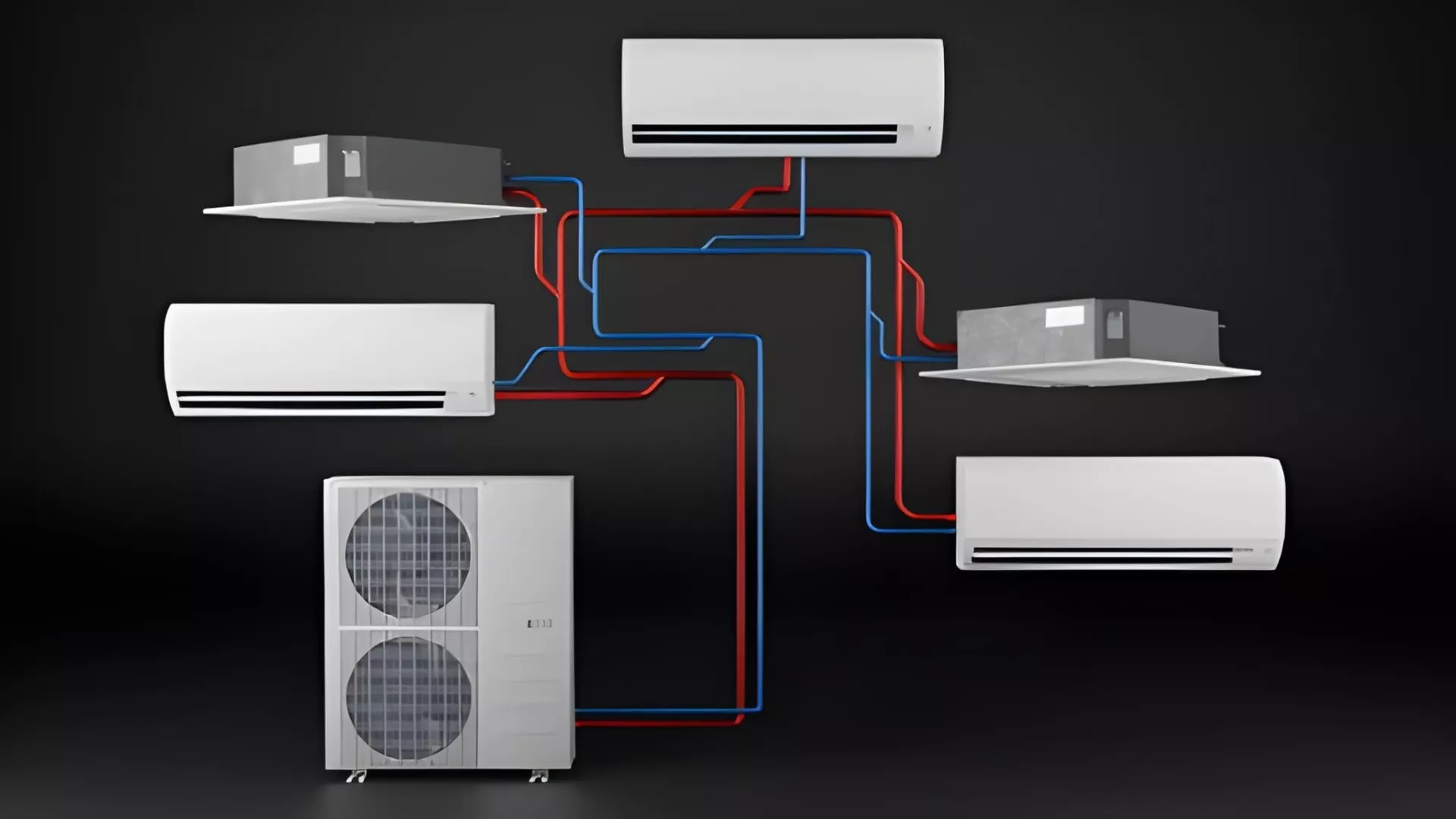
At its core, VRV technology uses three key components working together:
- Inverter-driven compressor: Continuously adjusts compressor speed to match the exact refrigerant demand of each zone — rather than switching on and off like a conventional system
- Electronic Expansion Valves (EEVs): Precisely meter refrigerant flow to each indoor unit independently
- Refrigerant piping network: Connects one or more outdoor units to up to 64 or more indoor units across the building
What Is VRF HVAC and How Does It Work?
VRF — The Generic Industry Term
VRF stands for Variable Refrigerant Flow. It is the generic industry term adopted by every major HVAC manufacturer that is not Daikin. Leading brands using the VRF designation include Mitsubishi Electric, Carrier, LG, Samsung, Midea, Toshiba, and Fujitsu — among many others. The technology is functionally identical to Daikin’s VRV in every measurable way.
Heat-Pump vs Heat-Recovery VRF — A Critical Distinction
All VRF systems fall into one of two categories — and choosing the right one matters significantly for your building’s performance:
- Heat-Pump (HP) VRF: The entire system operates in either heating mode or cooling mode at any given time. All zones must be in the same mode simultaneously. Best for buildings with uniform loads.
- Heat-Recovery (HR) VRF: Individual zones can heat or cool independently and simultaneously. Waste heat from cooling zones is captured and redirected to heating zones — dramatically improving efficiency. Best for mixed-use buildings with diverse zone loads.
How VRF Works — Step by Step
- The outdoor condensing unit houses the inverter compressor and acts as the system’s engine
- Refrigerant travels through small copper pipes to each indoor unit — no large ductwork required
- Electronic Expansion Valves at each indoor unit modulate refrigerant flow in real time
- Each indoor unit independently maintains its zone at the exact setpoint — whether 20°C (68°F) or 24°C (75°F)
- The system continuously recalculates and adjusts refrigerant distribution across all zones simultaneously
VRV vs VRF — The Only Real Difference (2026 Update)
Myth Busted — They Are Identical
This is the question that brings most people to this article — and the answer is refreshingly simple. There is zero technical difference between VRV and VRF. They use the same inverter compressor technology, the same electronic expansion valves, the same refrigerant piping principles, and deliver the same energy efficiency, comfort, and performance outcomes.
The confusion exists entirely because of trademark law. When Daikin patented the VRV name in 1982, competing manufacturers needed a different term for their equivalent technology. The global HVAC industry settled on VRF as the generic descriptor — and it has been used universally ever since.
Why Does This Confusion Still Exist in 2026?
Despite being a well-understood distinction within the HVAC industry, the VRV vs VRF question continues to confuse building owners, facility managers, and procurement teams. The reasons are straightforward:
- Daikin’s strong global brand presence keeps VRV prominent in specifications and tenders
- Different regions use different terms — VRV is more common in Asia and Europe; VRF dominates in North America
- Some consultants and specifiers use both terms interchangeably without explanation
🔑 The Bottom Line
VRV = Daikin’s trademark name. VRF = the generic industry term. Same technology. Same performance. Same efficiency. Different badge.
VRV vs VRF Technical Comparison — Are They Identical in Performance?
The Full Technical Comparison
For engineers and specifiers who need to confirm performance parity between VRV and VRF systems, the following table provides a complete technical comparison. All specifications reflect 2025–2026 top-tier models from leading manufacturers on both sides.
| Technical Feature | VRV (Daikin) | VRF (All Other Brands) |
|---|---|---|
| Full Name | Variable Refrigerant Volume | Variable Refrigerant Flow |
| Compressor Type | Inverter-driven | Inverter-driven |
| Flow Control | Electronic Expansion Valve (EEV) | Electronic Expansion Valve (EEV) |
| Simultaneous Heat/Cool | Yes — HR models | Yes — HR models |
| Cold-Climate Operation | Down to -30°C (-22°F) | Down to -30°C (-22°F) |
| Efficiency Rating (IEER) | 20–30+ (top models) | 20–30+ (top models) |
| Max Piping Length | Up to 300+ m (1,000+ ft) | Up to 300+ m (1,000+ ft) |
| Indoor Units Per System | Up to 64+ | Up to 64+ |
Performance Verdict — No Winner Because There Is No Race
The table above confirms what HVAC engineers already know: VRV and VRF systems are technically indistinguishable in performance. Your choice between them should be based on brand preference, local distributor support, warranty terms, lead times, and pricing — not on any technical superiority of one over the other.
“The VRV versus VRF debate is purely a branding conversation — not a technical one. Both technologies use identical inverter compressor principles and electronic expansion valve control. When specifying for a project, focus on manufacturer support, refrigerant compliance, and controls integration — not on which acronym appears in the product name.”
Cost Comparison — Upfront Investment vs 10-Year Lifecycle Savings
The Upfront Cost Reality
VRV and VRF systems cost more to install than traditional HVAC — and that is a fact worth addressing directly. The installed cost typically ranges from $16.50 to $33 per square foot, compared to $12–$18 per square foot for conventional rooftop unit or chilled-water systems. That translates to a 20–50% higher upfront investment depending on building size, system complexity, and local labour rates.
However, this upfront premium needs to be viewed in the context of what it replaces. Heat-recovery VRF/VRV systems eliminate the need for separate boilers and chillers in mixed-climate projects — saving an additional 15–20% on first cost compared to installing both systems separately.
Lifecycle Cost — Where VRF/VRV Wins Decisively
Over a 10-year period, the financial picture shifts dramatically in favour of VRF/VRV. Lower operating costs, reduced maintenance requirements, and eliminated duct losses combine to deliver substantial lifecycle savings.
| Cost Category | Traditional HVAC | VRV / VRF System |
|---|---|---|
| Installed Cost (per sq ft) | $12–$18 | $16.50–$33 |
| Annual Energy Cost | Baseline | 25–40% lower |
| Duct Losses | 10–30% energy loss | Near zero — ductless |
| Separate Boiler/Chiller Needed | Often yes | No — HR models replace both |
| Typical Break-Even Point | N/A | 3–7 years |
| 10-Year Total Cost | Higher in variable-load buildings | Lower — energy savings offset premium |
Energy Efficiency and Performance — Real-World Savings Data
What the Research Actually Shows
The energy efficiency case for VRV and VRF systems is backed by multiple independent studies and government data. The savings are consistent, significant, and well-documented across a wide range of U.S. climate zones and building types.
Energy Savings Data Table — Source by Source
| Source | Energy Savings | Context |
|---|---|---|
| U.S. Department of Energy | Up to 30% | vs conventional HVAC systems |
| Peer-Reviewed Studies (Kim et al.) | 15–42% site energy | vs RTU-VAV, all 16 U.S. climate zones |
| Mordor Intelligence (2025) | ~30% | Heat-recovery VRF vs split-DX in offices |
| U.S. GSA Field Studies | >34% HVAC energy | Commercial buildings — field measured |
The Heat Recovery Efficiency Advantage
Heat-recovery VRF/VRV systems deliver an additional efficiency layer that conventional systems simply cannot match. By capturing waste heat from cooling zones and redirecting it to heating zones, the system eliminates the need to run a chiller and boiler simultaneously. In a typical mixed-use office building on a mild day — where perimeter offices need heating to 21°C (70°F) while interior server rooms need cooling — a heat-recovery VRF system handles both loads using a fraction of the energy a conventional system would consume.
“Heat-recovery VRF technology represents one of the most significant efficiency advances in commercial HVAC in the past two decades. The ability to simultaneously transfer heat between zones — rather than rejecting it outdoors — fundamentally changes the energy equation for mixed-use buildings.”
Pros and Cons of VRV/VRF Systems vs Traditional HVAC
The Honest Trade-Off Assessment
VRV and VRF systems are outstanding performers — but they are not the right choice for every project. Here is an honest, balanced assessment of their strengths and limitations compared to traditional HVAC.
| ✅ VRV/VRF Pros | ❌ VRV/VRF Cons |
|---|---|
| Precise zone-by-zone temperature control | 20–50% higher upfront cost vs traditional HVAC |
| Up to 30–42% energy savings | Requires specialist refrigerant piping design |
| No duct losses — ductless or minimal duct | Complex for very large systems over 100 tons |
| Simultaneous heating and cooling (HR models) | Requires certified technicians for refrigerant work |
| Quiet operation — no noisy air handlers | Refrigerant leak risk in enclosed spaces |
| Modular and scalable — easy to expand | Not cost-effective for single-zone or simple loads |
| Ideal for retrofits — minimal structural disruption | Higher GWP concern — mitigated with R-32 refrigerant |
🧭 Is VRV/VRF Right for Your Building?
- ✅ Yes — if your building has multiple zones with variable or mixed loads
- ✅ Yes — if energy efficiency and occupant comfort are top priorities
- ✅ Yes — if you are retrofitting a building where adding ductwork is impractical
- ❌ No — if your building is a single large open space with uniform loads
- ❌ No — if upfront budget constraints make the premium unworkable
Best Applications — When to Choose VRV or VRF for Your Building
Where VRV/VRF Delivers the Most Value
VRV and VRF systems perform best in buildings where zone loads vary significantly — either by time of day, occupancy pattern, or building orientation. The more diverse the thermal demands across zones, the greater the efficiency and comfort advantage over traditional systems.
Ideal Applications by Building Type
- Hotels: Each guest room maintains its own temperature independently — 20°C (68°F) in one room, 23°C (73°F) next door — without affecting other rooms
- Hospitals: Operating theatres, wards, and offices all have drastically different temperature and IAQ requirements — VRF handles all simultaneously
- Commercial offices: South-facing offices need cooling while north-facing rooms need heating on the same mild day — heat-recovery VRF manages both efficiently
- Schools and universities: Classrooms, labs, gyms, and administrative offices all have different schedules and loads
- Retail and mixed-use: Different tenants, different hours, different loads — VRF gives each zone full independence
- Historical building retrofits: No ductwork required — VRF preserves architectural integrity while delivering modern comfort
- Data centers: Server rooms need constant cooling regardless of outdoor temperature or season
When NOT to Choose VRF/VRV
- Single-zone warehouses or factories — uniform loads do not benefit from VRF’s zoning capability
- Extremely budget-constrained new builds — where the upfront premium cannot be justified by the building’s revenue profile
- Very large systems over 100 tons — where chilled water systems may offer better scalability and serviceability
🧭 Quick Application Guide
| Building Type | VRF/VRV Recommended? | Best Model Type |
|---|---|---|
| Hotel | ✅ Strongly Yes | Heat Recovery |
| Hospital | ✅ Strongly Yes | Heat Recovery |
| Commercial Office | ✅ Yes | Heat Recovery |
| Historical Retrofit | ✅ Ideal | Heat Pump or HR |
| School / University | ✅ Yes | Heat Pump |
| Single-Zone Warehouse | ❌ Not Recommended | Consider traditional HVAC |
| Data Center Support Zones | ✅ Yes | Heat Recovery |
Thermostat and Controls Guide for VRV/VRF Systems
Protocol Compatibility — What Your VRF System Needs
Both VRV and VRF systems are fully compatible with industry-standard building automation protocols. Most manufacturers provide native gateway options, but the most flexible and future-proof approach is to use a smart thermostat with built-in multi-protocol support. The three most common protocols used with VRF/VRV systems are:
- Modbus RTU/TCP — the most widely supported protocol for VRF field device integration
- BACnet IP/MS/TP — preferred for full BMS integration with trending, alarming, and scheduling
- Native manufacturer protocols — Daikin D-BACS, Mitsubishi M-NET, LG LGAP — used for direct system integration
What Smart Thermostats Need to Work With VRF/VRV
When specifying thermostats for a VRF or VRV system, ensure your chosen device supports the following:
- 2-stage or modulating outputs: 0–10V or 4–20mA signals for precise valve and fan control
- Heat-pump or heat-recovery logic: The thermostat must understand whether the system is in HP or HR mode to control outputs correctly
- Setpoint range: Typically 16°C–30°C (61°F–86°F) with 0.5°C (1°F) resolution for precise comfort control
- Occupancy input: PIR sensor or BMS occupancy signal integration for demand-controlled setback
Smart Features That Add 10–15% Additional Savings
The right smart thermostat does more than just control temperature. When paired with a VRF or VRV system, these smart features deliver measurable additional energy savings:
- Geofencing: Pre-conditions rooms before occupants arrive — eliminates cold or hot startups
- Occupancy sensing: Automatically sets back to 26°C (79°F) when a room is empty — avoids conditioning unoccupied spaces
- Scheduling: Aligns system operation precisely with building occupancy calendars
- Energy reporting: Real-time consumption data helps facility managers identify waste and optimise setpointsne device, any system
People Also Ask — VRV vs VRF HVAC
Your Top Questions Answered
These are the most common questions people search for when comparing VRV vs VRF HVAC systems. Each answer is kept short and clear for fast reference and featured snippet targeting.
❓ Are VRV and VRF the same thing?
Yes — 100% identical technology. VRV is Daikin’s registered trademark for their variable refrigerant system, coined in 1982. VRF is the generic industry term used by every other manufacturer. The performance, efficiency, installation process, and operating principles are completely identical. Only the name differs.
❓ What is the difference between VRV and VRF?
The difference is purely branding and trademark — not technology. Daikin trademarked VRV (Variable Refrigerant Volume) in 1982. All other manufacturers — Mitsubishi, Carrier, LG, Samsung, and others — use VRF (Variable Refrigerant Flow) as the generic equivalent. There is no performance, efficiency, or technical difference between the two terms.
❓ Which is better — VRV or VRF?
Neither is technically superior. Both deliver identical efficiency, comfort, and performance. Your choice should be based on brand preference, local distributor support, warranty terms, pricing, and lead times — not on any technical advantage of one acronym over the other. Daikin VRV often has strong brand recognition; other VRF brands frequently offer better pricing or faster availability.
❓ Can VRF systems heat and cool at the same time?
Yes — but only heat-recovery (HR) models. Heat-recovery VRF/VRV systems can simultaneously heat some zones while cooling others — capturing waste heat from cooling zones and redirecting it to heating zones. Heat-pump (HP) models cannot — all zones must operate in the same mode at the same time.
❓ How much do VRV/VRF systems cost compared to traditional HVAC?
Upfront: VRF/VRV systems cost 20–50% more than traditional HVAC — typically $16.50–$33 per square foot installed. Long-term: They deliver 25–40% lower annual operating costs. The typical break-even point is 3–7 years in commercial buildings — after which the energy savings compound for the life of the system.
❓ Are VRV/VRF systems more energy efficient?
Yes — significantly. The U.S. DOE confirms up to 30% energy savings vs conventional HVAC. Independent peer-reviewed studies show 15–42% site energy savings vs RTU-VAV systems across all U.S. climate zones. Heat-recovery models deliver additional savings by eliminating simultaneous chiller and boiler operation in mixed-climate buildings.
Final Verdict — VRV or VRF? Making the Right Choice for Your Project
Stop Comparing VRV and VRF — Start Comparing Brands
The final verdict on VRV vs VRF is simple: stop comparing the acronyms and start comparing the brands. Since the technology is identical, your evaluation should focus entirely on the factors that actually differ between manufacturers:
- Local distributor and service support — who can service the system quickly when something goes wrong?
- Warranty terms — what is covered and for how long?
- Pricing and lead times — especially critical in supply-constrained markets
- Controls ecosystem — does the manufacturer’s native controls platform integrate with your BMS?
- Refrigerant compliance — is the system using R-32 or another low-GWP refrigerant compliant with AIM Act and F-Gas regulations?
Final Verdict Summary Table
| Decision Factor | VRV (Daikin) | VRF (Other Brands) |
|---|---|---|
| Technical Performance | 🏆 Equal | 🏆 Equal |
| Energy Efficiency | 🏆 Equal | 🏆 Equal |
| Brand Recognition | 🏆 Strong globally | Varies by brand |
| Pricing | Premium positioning | 🏆 Often more competitive |
| Market Availability | Strong in Asia/Europe | 🏆 Dominant in North America |
| Controls Flexibility | 🏆 Equal with smart thermostats | 🏆 Equal with smart thermostats |
| Overall ROI | 🏆 Equal | 🏆 Equal |
Conclusion: Future-Proof Your Building with VRV/VRF and Smart Controls
What We Have Learned
After covering everything from the 1982 origins of VRV to the 2030 market forecast, the key takeaways from this guide are clear and actionable:
- VRV and VRF are identical technology — the only difference is Daikin’s trademark vs the generic industry term
- Both deliver up to 30–42% energy savings vs conventional HVAC — confirmed by the U.S. DOE and multiple independent studies
- Heat-recovery models are the most efficient choice for mixed-use buildings with diverse zone loads
- The upfront premium pays back in 3–7 years — after which the savings compound for the life of the system
- The global VRF market is growing at 9.84% annually — driven by electrification, refrigerant regulations, and smart building demand
- Smart thermostats add 10–15% additional savings on top of the system’s inherent efficiency — making controls selection as important as system selection
