
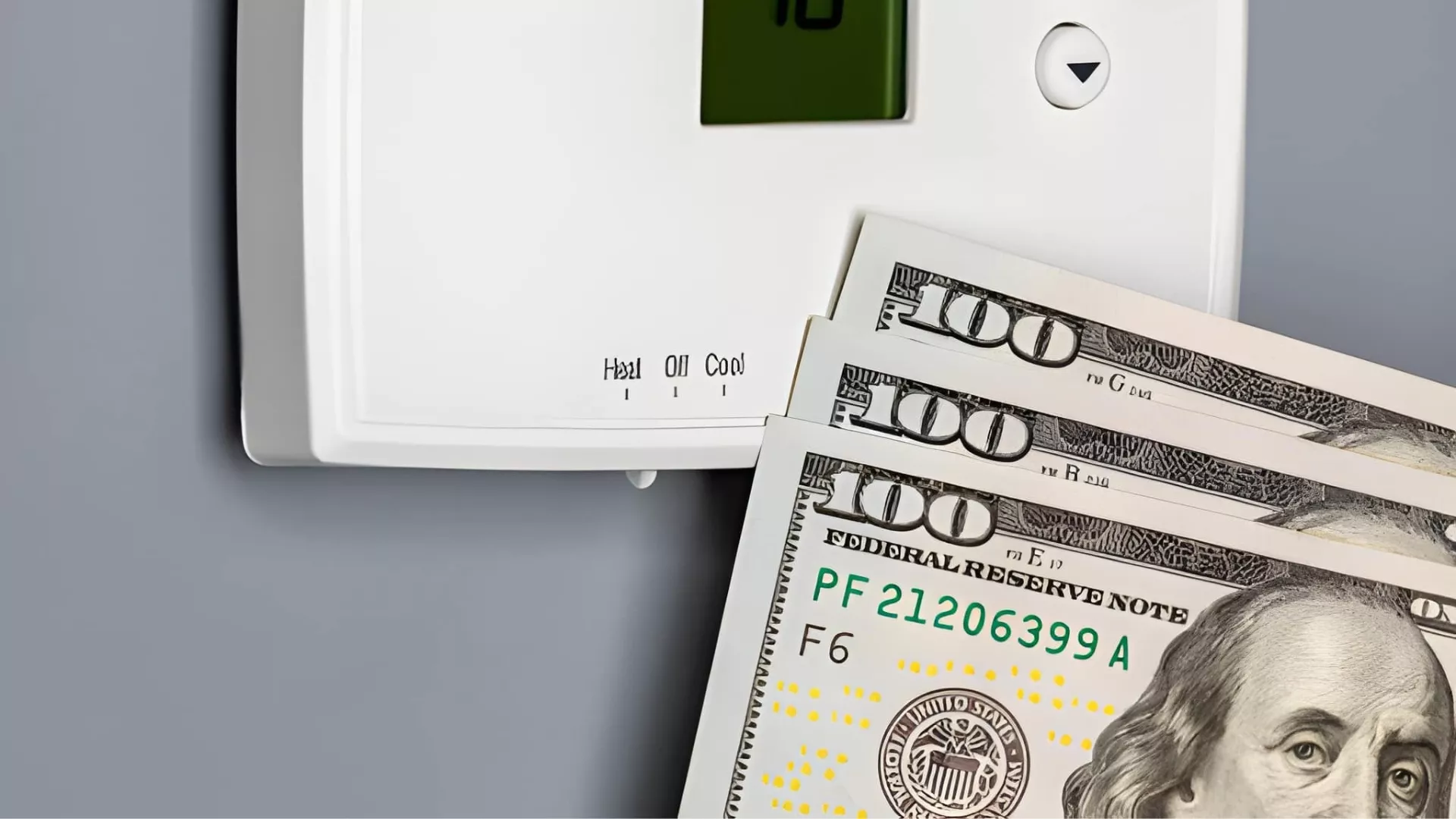
⚡ Quick Answer: What Does a Programmable Thermostat Cost?
A programmable thermostat costs $100–$340 in total for most homeowners in 2026 — including the unit and installation. The device itself ranges from $20 for a basic model to $150 for a Wi-Fi programmable unit. DIY installation is free. Professional installation adds $80–$200. With utility rebates of $50–$100 available on many models, your net cost can drop significantly — and the investment pays back in 1–2 years through energy savings.
Programmable Thermostat Cost: Quick Snapshot (2026)
| Option | Unit Price | Installation | Total Cost |
|---|---|---|---|
| Budget (Basic Programmable) | $20–$60 | $0–$100 | $20–$160 |
| Mid-Range (Wi-Fi Programmable) | $80–$150 | $100–$200 | $180–$340 |
| Premium (Smart-Enabled) | $116–$300 | $150–$250 | $300–$500+ |
🔑 5 Key Takeaways
- Basic programmable thermostats start at just $20–$60 — one of the cheapest home energy upgrades available
- The national average for professional thermostat installation is $184 — but most basic models are easy DIY
- Utility rebates of $50–$100 are available on many ENERGY STAR models — reducing net cost significantly
- Programmable thermostats save up to 10% on heating and cooling bills — paying back in just 1–2 years
- Programmable units hold a 27% share of the $9.22 billion global thermostat market in 2026 — proving strong real-world value
Programmable Thermostats Explained — Simple Scheduling for Everyday Savings
What a Programmable Thermostat Does
A programmable thermostat is a simple but powerful device that automatically adjusts your home’s temperature based on a schedule you set once. Instead of manually changing the temperature every time you leave or go to bed, you programme it in advance — and it handles everything from that point on. When you are away at work, it eases back the heating or cooling. When you are about to return home, it restores your comfortable temperature automatically. The result is a home that is always comfortable when you need it — and never wasting energy when you do not.
How Scheduling Prevents Wasted Energy
The biggest energy waste in most homes is simple forgetfulness. People leave for work without adjusting the thermostat. They go to bed with the heating running at full daytime levels. A programmable thermostat eliminates this entirely. It uses four daily scheduling periods — Wake, Leave, Return, and Sleep — to match your HVAC system’s activity to your actual daily routine. Furthermore, most models offer separate weekday and weekend schedules, so your Saturday morning lie-in does not mean wasting energy on an empty house pattern.
Compatibility and Ease of Use
Most programmable thermostats are designed to work with standard 24V residential HVAC systems — including gas furnaces, central air conditioners, and heat pumps. They are also built to be genuinely easy to use. Basic models have straightforward button interfaces. Mid-range models add digital displays. Wi-Fi models add app control. Regardless of tier, the core function — set a schedule once and save energy automatically — remains the same. For busy households that simply do not have time to manually adjust the temperature multiple times a day, a programmable thermostat is one of the most practical home upgrades available.
Current Unit Prices for Programmable Thermostats in 2026
Why Unit Price Varies So Much
The price range for programmable thermostats is wider than most people expect — from under $25 to over $150 for the unit alone. This variation is driven by three main factors: display type (basic LCD vs colour touchscreen), connectivity (no Wi-Fi vs full app control), and scheduling depth (basic 5-2 day vs full 7-day with multiple daily periods). Understanding which features you actually need is the key to avoiding overpaying for capabilities you will never use.
Basic Digital Programmable Models: $20–$60
Entry-level programmable thermostats deliver the core scheduling function at the lowest possible price. These models — like the Honeywell RTH221B ($24–$41) and basic Emerson models — offer:
- Simple button-based programming
- Basic digital display showing time and temperature
- 5-2 day or 7-day scheduling
- No Wi-Fi or app connectivity
- Battery-powered or hardwired operation
For homeowners with a consistent daily routine who simply want to stop manually adjusting the thermostat, these models deliver the full DOE 10% energy savings at the lowest possible cost.
Mid-Range and Wi-Fi Programmable Models: $41–$150
Mid-range programmable thermostats add Wi-Fi connectivity and app control — giving you the ability to adjust your schedule remotely from your smartphone. Key models in this range include the Copeland Sensi ($41–$116) and mid-range Honeywell Home models. These offer:
- Full 7-day scheduling with multiple daily periods
- Wi-Fi connectivity and smartphone app control
- Cleaner digital or touchscreen displays
- ENERGY STAR certification on many models
- Compatibility with most standard HVAC systems
Unit Price Comparison Table (2026)
| Model Tier | Price Range | Key Features | Best For |
|---|---|---|---|
| Basic Digital Programmable | $20–$60 | Button interface, basic display, 5-2 or 7-day schedule | Tight budgets, simple routines |
| Mid-Range 7-Day Programmable | $80–$150 | Cleaner display, more periods, better interface | Most homeowners |
| Wi-Fi Programmable (Sensi, Honeywell) | $41–$116 | App control, Wi-Fi, ENERGY STAR, remote access | App users, frequent travellers |
| Premium Smart-Enabled | $116–$300 | Touchscreen, learning, geofencing, voice control | Smart home enthusiasts |
Installation Costs — DIY vs Professional in 2026
DIY Installation: $0 and Under 60 Minutes
For most basic and mid-range programmable thermostats, DIY installation is entirely achievable — even for homeowners with no electrical experience. The process involves turning off the HVAC breaker, removing the old thermostat faceplate, photographing the existing wiring, connecting the wires to the new base (following the app guide or included instructions), and restoring power. Most basic models take 30–45 minutes. Wi-Fi models with app-guided setup take 45–60 minutes. Your only cost is the device itself — making DIY the highest-value option for compatible systems.
When to Hire a Professional
Professional installation makes sense in specific situations. These include:
- 🔧 Multi-stage HVAC systems — 2H/2C or heat pump setups with complex wiring
- 📡 Wi-Fi thermostats on older systems without a C-wire
- 🏠 Homes with non-standard wiring or older low-voltage systems
- ✅ Warranty protection — some manufacturers require professional installation for warranty coverage
- 🕐 Time constraints — if you simply prefer to have it done correctly and quickly
Installation Cost Comparison Table (2026)
| Installation Type | Cost Range | Time Required | Best For |
|---|---|---|---|
| DIY — Basic Model | $0 | 30–45 minutes | Standard systems, confident homeowners |
| DIY — Wi-Fi Model | $0 | 45–60 minutes | App-guided setup, standard wiring |
| Professional — Labour Only | $80–$200 | 1–2 hours | Complex systems, warranty requirements |
| Professional — Unit + Labour | $100–$340 (avg $184) | 1–3 hours | Full service, peace of mind |
National average for any thermostat replacement: $184. Source: 2026 HomeAdvisor and Angi cost data.
Total Cost Breakdown — Budget to Premium Options
How to Think About Total Cost of Ownership
The smartest way to evaluate programmable thermostat cost is to look at total cost of ownership — not just the sticker price. This means adding the unit price, installation cost, and any ongoing costs (like annual batteries at $5–$10). Then subtract any utility rebates you qualify for. The result is your true net investment — and when you compare that against annual energy savings, the payback picture becomes very clear very quickly.
Budget Option: $20–$160 Total
A basic programmable thermostat — like the Honeywell RTH221B at $24–$41 — combined with a free DIY installation brings your total cost to as little as $20–$60. Even with professional installation added, the total stays under $160. This tier delivers the full DOE 10% energy savings through scheduled setbacks. It is the best choice for homeowners on a tight budget, rental properties, or anyone who wants maximum simplicity with minimum investment. Payback at this price point can occur in under 6 months.
Mid-Range Option: $180–$340 Total
A Wi-Fi programmable thermostat — like the Copeland Sensi at $80–$116 — plus professional installation brings the total to $180–$340. This tier adds app control, remote access, and ENERGY STAR certification. For most homeowners, this represents the best value sweet spot — meaningful smart features at a fraction of the cost of a full learning thermostat. Payback typically occurs within 12–18 months.
Full Total Cost Breakdown Table (2026)
| Type | Unit Price | Installation | Total Cost | Best For |
|---|---|---|---|---|
| Basic Programmable | $20–$60 | $0–$100 | $20–$160 | Simple homes, tight budgets |
| Wi-Fi Programmable | $80–$150 | $100–$200 | $180–$340 | Most homeowners |
| Premium Smart-Enabled | $116–$300 | $150–$250 | $300–$500+ | App lovers, max savings |
Energy Savings and Real ROI Data You Can Expect
The DOE Benchmark: Up to 10% Savings
The U.S. Department of Energy has tested programmable thermostat savings consistently for decades — and the finding is clear. Turning your thermostat back 7–10°C (12–18°F) for 8 hours a day saves up to 10% on annual heating and cooling costs. For the average U.S. household, heating and cooling represent 40–50% of the total energy bill. Therefore, a 10% reduction in that category translates directly into $50–$140 per year in real dollar savings — depending on your climate, home size, and energy rates.
The 1°C Rule — How Every Degree Counts
Here is the simplest way to understand the savings. Every 1°C (1.8°F) you set back your thermostat for 8 hours saves approximately 1% on your energy bill. A typical overnight setback from 21°C (70°F) to 15°C (59°F) — a 6°C (11°F) drop — saves around 6% just from sleeping. Add a similar setback during the workday, and you approach the full DOE 10% figure. A programmable thermostat automates this process so you never have to think about it again.
Savings and ROI Comparison Table (2026)
| Metric | Savings Amount | Payback Period | Source |
|---|---|---|---|
| Annual Energy Reduction | Up to 10% on heating/cooling | 1–2 years | U.S. DOE / Energy.gov |
| Average Yearly Dollar Savings | $50–$140/year | — | ENERGY STAR / independent studies |
| vs Manual Thermostat | 8–10% extra | Immediate | DOE setback guidelines |
| Overall HVAC Bill Impact | 10–15% typical | 1–3 years | Field data from major brands |
Source: U.S. Department of Energy, ENERGY STAR, and 2026 field data from Honeywell and Emerson.
“Programmable thermostats remain one of the most cost-effective energy efficiency investments a homeowner can make. The payback period is short, the installation barrier is low, and the savings are consistent and well-documented. When we look at the full lifecycle cost — purchase price minus rebates, divided by annual savings — programmable thermostats consistently outperform most other home energy upgrades on a pure return-on-investment basis. The key is simply making sure the schedule is set correctly and actually reflects how the household lives.”
Programmable vs Smart Thermostats — Cost vs Features Comparison
The Total Cost Gap
The most common question homeowners face when shopping for a thermostat upgrade is whether to choose a programmable model or step up to a full smart thermostat. The cost difference is significant. A programmable thermostat costs $100–$340 in total (unit plus installation). A smart learning thermostat costs $200–$500+ — with premium models like the ecobee Premium or Google Nest at the higher end. That is a gap of $100–$200 or more for the same core function of scheduled temperature control.
What Smart Thermostats Add
Smart thermostats justify their higher price through three capabilities that programmable models cannot match:
- 🧠 Auto-learning — adapts to your routine over time without manual reprogramming
- 📍 Geofencing — detects when you leave and arrive, adjusting automatically
- 📱 Full remote control — change settings instantly when your schedule changes unexpectedly
These features push smart thermostat savings to 10–23% in 2025–2026 testing — versus the programmable model’s consistent 10%. The extra savings are real but modest for households with consistent routines.
Cost vs Features Comparison Table (2026)
| Factor | Programmable Thermostat | Smart Thermostat |
|---|---|---|
| Total Cost | $100–$340 | $200–$500+ |
| Energy Savings | Up to 10% | 10–23% |
| Auto-Learning | No | Yes |
| Geofencing | No | Yes |
| Voice Control | Limited (Wi-Fi models only) | Full Alexa/Google/HomeKit |
| Payback Period | 1–2 years | 2–3 years |
| Best For | Consistent schedules, budget focus | Irregular schedules, zero-effort automation |
When Programmable Wins — and When to Go Smart
Choose a programmable thermostat if you have a consistent daily routine, want the fastest payback, and are comfortable setting a schedule once. Choose a smart thermostat if you travel frequently, have an irregular schedule, or want the convenience of zero-effort automation. For most households with predictable weekday routines, a correctly programmed thermostat delivers virtually identical core savings at 30–50% lower cost.
Factors That Affect Your Final Programmable Thermostat Cost
Factor 1: Brand and Display Features
The brand you choose and the display type have a direct impact on unit price. A basic LCD button-interface model from Emerson or Honeywell sits at the lower end of the price range. Adding a colour touchscreen display typically adds $20–$50 to the unit price — without necessarily adding meaningful energy-saving capability. Before paying for a touchscreen, ask yourself honestly whether you will use the on-device interface regularly — or whether you will manage everything through the app anyway. If app control is your primary method, a simpler display at a lower price point delivers identical performance.
Factor 2: Wi-Fi Capability
Adding Wi-Fi connectivity to a programmable thermostat typically adds $40–$100 to the unit price compared to a non-connected equivalent. However, Wi-Fi models also qualify for ENERGY STAR certification more frequently — which unlocks utility rebates that can offset much of that premium. Furthermore, Wi-Fi models allow you to adjust your schedule remotely when your routine changes unexpectedly — preventing the wasted energy that occurs when a non-Wi-Fi model runs its programmed schedule on a day you stayed home sick or returned early from a trip.
Factor 3: HVAC System Compatibility
Your existing HVAC system type directly affects which thermostats you can use — and therefore your cost options. A simple single-stage gas furnace and AC system is compatible with the widest range of models, including the cheapest. A heat pump system requires a 2H/1C thermostat — which narrows the compatible model range and typically pushes the unit price slightly higher. A system without a C-wire may require a battery-powered model or an adapter kit — adding $0–$50 to your total cost. Always check compatibility before purchasing.
Factor 4: Location and Labour Rates
If you choose professional installation, your location significantly affects the labour cost. In high-cost-of-living metropolitan areas — like New York, San Francisco, or Boston — HVAC technician labour rates can push installation costs toward the upper end of the $80–$200 range or beyond. In smaller cities and rural areas, the same installation may cost $60–$100. The national average sits at $184 for a full thermostat replacement including unit and labour. Getting two or three quotes from local HVAC contractors is always worth the effort before committing.
Factor 5: Utility Rebates — How to Reduce Net Cost to Near Zero
This is the most overlooked factor in programmable thermostat cost — and potentially the most impactful. Many utility companies offer $50–$100 rebates on ENERGY STAR-certified programmable and smart thermostat purchases. In some states, additional energy efficiency programme incentives stack on top of utility rebates. To find available rebates in your area:
- 🔍 Visit energystar.gov/rebate-finder and enter your zip code
- 🏢 Check your utility company’s website directly under “rebates” or “energy efficiency”
- 📞 Call your utility provider — some rebates are not prominently advertised online
A $100 rebate on a $116 Sensi Wi-Fi thermostat effectively brings your unit cost to just $16 — making the payback period almost instantaneous.
Is a Programmable Thermostat Worth It in 2026?
The Direct Verdict
Yes — for almost every homeowner, a programmable thermostat is absolutely worth the cost in 2026. The maths are straightforward and compelling. At a total cost of $20–$340 and annual savings of $50–$140, the investment pays back in 1–2 years in most cases. After payback, every year of savings is pure net gain. Over a 10-year thermostat lifespan, most homeowners pocket $400–$1,200 in cumulative energy savings after accounting for the purchase price — from a device that requires almost no ongoing effort or maintenance.
Market Validation: The Numbers Speak
The global market confirms this value proposition. The worldwide thermostat market is projected to reach $9.22 billion in 2026 — growing at an 18.19% CAGR. Programmable thermostats hold a 27% share of this market — a substantial position that reflects real consumer confidence in the technology’s value. Homeowners and property managers around the world continue to choose programmable models because the combination of low cost, fast payback, and proven savings is genuinely hard to beat among home energy upgrades.
The Cost of NOT Upgrading
Here is a perspective that many articles overlook. If you are currently using a manual thermostat — one without any scheduling function — you are likely leaving $50–$140 on the table every single year through unnecessary heating and cooling. Over five years, that is $250–$700 in avoidable energy costs. The longer you delay upgrading, the more that number grows. A $40 basic programmable thermostat installed this weekend could prevent hundreds of dollars in wasted energy before the end of the decade.
Final Recommendation by Household Type
- 🏠 Budget-conscious homeowner with consistent routine: Basic programmable at $20–$60 — fastest payback, zero complexity
- 📱 Tech-comfortable homeowner who travels occasionally: Wi-Fi programmable at $80–$150 — best value with app flexibility
- 🧠 Busy household with irregular schedule: Consider stepping up to a smart thermostat — the auto-learning justifies the extra cost
- 🏘️ Landlord or rental property owner: Basic programmable — durable, simple, lowest replacement cost
- 👴 Senior or accessibility-focused household: Button-interface programmable — tactile, reliable, zero learning curve
Frequently Asked Questions
How much does it cost to install a programmable thermostat?
The total cost to install a programmable thermostat in 2026 ranges from $20 to $340 depending on the model and installation method. A basic model with DIY installation costs as little as $20–$60 — just the device price with no labour cost. A Wi-Fi programmable model with professional installation typically costs $180–$340 total. The national average for a full thermostat replacement — including unit and professional labour — is $184. With utility rebates of $50–$100 applied, your net cost can drop significantly below these figures.
Are programmable thermostats worth the cost?
Absolutely — and the data backs this up clearly. A programmable thermostat saves up to 10% on annual heating and cooling costs — roughly $50–$140 per year for the average U.S. household. At a total cost of $20–$340, the investment pays back in 1–2 years in most cases. After payback, every year of savings is pure net gain. Programmable thermostats are consistently cited by energy efficiency experts as one of the highest-return, lowest-barrier home energy upgrades available — particularly when utility rebates are factored in.
How much can a programmable thermostat save on my energy bill?
The U.S. Department of Energy confirms savings of up to 10% per year on heating and cooling bills through proper programmable setbacks. In dollar terms, that equals $50–$140 annually for the average household — with larger homes in extreme climates potentially saving more. The key driver is the 7–10°C (12–18°F) setback rule — turning the temperature back for 8 or more hours while you sleep or are away. Every 1°C (1.8°F) setback for 8 hours saves approximately 1% on your bill. A correctly programmed thermostat automates this savings process completely.
What is the cost difference between programmable and smart thermostats?
Programmable thermostats cost $100–$340 in total (unit plus installation). Smart learning thermostats cost $200–$500+ in total — typically $100–$200 more than a comparable programmable model. Smart thermostats add auto-learning, geofencing, and deeper app integration — pushing savings to 10–23% versus the programmable model’s consistent 10%. For households with consistent daily routines, the programmable model delivers virtually identical core savings at significantly lower cost. The smart thermostat premium is best justified for households with irregular schedules or those who want completely hands-off automation.
Do I need a professional to install a programmable thermostat?
No — for most basic and Wi-Fi programmable models, DIY installation is entirely achievable. Most homeowners complete a standard thermostat swap in 30–60 minutes using the manufacturer’s app guide or included instructions. The low-voltage 24V wiring used in standard residential HVAC systems is safe to handle without specialist electrical training — as long as you turn off the HVAC breaker first. Professional installation ($80–$200 in labour) is recommended for multi-stage HVAC systems, heat pump setups, homes without a C-wire, or situations where manufacturer warranty requires professional commissioning.
Conclusion
The Real Cost of a Programmable Thermostat — and Why It Is Worth Every Penny
The answer to the question this article started with is clear and reassuring. A programmable thermostat costs $20 at the very minimum and $340 at the high end of a professionally installed Wi-Fi model. For most homeowners, the realistic total investment sits between $100 and $250 — and with utility rebates applied, it can drop to under $100. That is a genuinely modest investment for a device that pays for itself in 1–2 years and then continues generating savings for a decade or more.
The programmable thermostat cost conversation ultimately comes down to one simple comparison. Spend $20–$340 once. Save $50–$140 every single year after that. No other home energy upgrade offers that combination of low barrier, fast payback, and consistent long-term return at this price point. The global market — worth $9.22 billion in 2026 — reflects the confidence that millions of homeowners and property managers have already placed in this technology.
Whether you choose a $40 basic model from Honeywell or a $116 Wi-Fi Sensi with app control, the core savings mechanism is identical — scheduled setbacks that reduce HVAC runtime when you do not need full comfort. Set the schedule once. Let it run. Watch the savings accumulate on every energy bill from the first month onward.
