
⚡ Quick Answer: Line Voltage vs Low Voltage Thermostat
The core difference is simple — it is all about voltage. Here is what you need to know right away:
- 🔵 Low voltage thermostats run on 24V AC — used with central furnaces, boilers, and heat pumps
- 🔴 Line voltage thermostats run on 120V or 240V — used with electric baseboard and radiant floor heaters
- ⚠️ You cannot swap one for the other without a proper conversion kit
- 🏆 For most modern homes: Low voltage wins on safety, smart features, and efficiency
| Feature | Low Voltage Thermostat | Line Voltage Thermostat |
|---|---|---|
| Operating Voltage | 24V AC | 120V or 240V |
| Typical Systems | Furnaces, boilers, heat pumps | Baseboard, radiant floor, in-wall heaters |
| Wiring | 4–8 thin control wires | 2 heavy-gauge power wires |
| Market Share (2025) | 48.10% of thermostat market | ~20–25% of market |
| Safety | ✅ Very safe (low power) | ⚠️ Higher risk if mishandled |
| Smart Compatibility | ✅ Excellent (Nest, Ecobee) | ⚠️ Specialised models only |
| Average Unit Price | $30–$150+ | $25–$60 |
What Is a Low Voltage Thermostat?
The Simple Definition
A low voltage thermostat operates on just 24V AC power — supplied by a small transformer built into your HVAC system. Instead of directly switching a high-power electrical circuit, it sends a gentle low-power signal to a relay or control board inside your furnace, boiler, or heat pump. That relay then does the heavy lifting of turning the system on or off.
Think of it like a light switch that tells a much bigger switch what to do — safely and precisely, from a distance.
Why It Dominates Modern HVAC Systems
Low voltage thermostats are the standard choice for central HVAC systems across North America and most of the world. In 2025, they held 48.10% of the total thermostat market — and that share is growing. Here is why they are so popular:
- ✅ Safer to handle — 24V poses minimal shock risk during installation
- ✅ More precise temperature control — thin signal wires respond quickly and accurately
- ✅ Full smart thermostat compatibility — works with Nest, Ecobee, Honeywell, and virtually every major smart platform
- ✅ Easy multi-zone setup — one system can control multiple areas of your home
What Systems Use Low Voltage?
If your home has a central forced-air furnace, a boiler, or a heat pump, you almost certainly have a low voltage thermostat already. These systems use the transformer built into the air handler or furnace to step down household voltage to a safe 24V AC signal — powering your thermostat and control wiring without any risk to you or your family.
What Is a Line Voltage Thermostat?
The Simple Definition
A line voltage thermostat runs directly on your home’s full household electrical current — either 120V or 240V AC. Unlike a low voltage thermostat that sends a signal to a relay, a line voltage thermostat physically switches the high-power circuit on and off. It is wired directly into the same electrical circuit as your heater — making it both the controller and the switch.
Where Line Voltage Thermostats Are Used
Line voltage thermostats are designed specifically for electric resistance heating systems, including:
- 🔴 Electric baseboard heaters — the most common application
- 🔴 Radiant floor heating systems — heated tiles or underfloor electric mats
- 🔴 In-wall electric panel heaters
- 🔴 Ceiling radiant heating panels
These systems do not have a central air handler or transformer — so the thermostat must handle the full electrical load directly. This makes line voltage thermostats simpler in design but more limited in features.
The Key Trade-Off
Because line voltage thermostats carry full household current, they generate more internal heat and carry a higher electrical load than low voltage models. They are also incompatible with standard smart thermostats like Nest or Ecobee — which are designed only for 24V systems. However, for homes with electric baseboard heating, a line voltage thermostat is not optional — it is required by design.
Line Voltage vs Low Voltage Thermostats: Key Differences at a Glance
Understanding the Core Differences
Now that you know what each type is, let us look at how they compare across every factor that matters for homeowners and HVAC professionals. The table below is your complete side-by-side reference.
| Feature | Low Voltage Thermostat | Line Voltage Thermostat |
|---|---|---|
| Operating Voltage | 24V AC (transformer-powered) | 120V or 240V (household power) |
| Typical Systems | Central furnaces, boilers, heat pumps | Baseboard, radiant floor, in-wall heaters |
| Wiring | 4–8 thin control wires | 2 heavy-gauge power wires |
| Market Share (2025) | 48.10% of thermostat market | ~20–25% of market |
| Safety Level | ✅ Very safe (low power signal) | ⚠️ Higher shock/fire risk if mishandled |
| Smart Compatibility | ✅ Excellent (Nest, Ecobee, etc.) | ⚠️ Specialised models only (Mysa, Cadet) |
| Average Unit Price | $30–$150+ | $25–$60 |
| Installation | DIY-friendly in most cases | Licensed electrician recommended |
The Most Important Differences — Highlighted
Three differences stand out above all others:
- ⚡ Voltage gap is massive — 24V vs 120/240V is not a small difference. It affects safety, wiring, compatibility, and everything else downstream.
- 📱 Smart thermostat access — Low voltage opens the door to virtually every smart thermostat on the market. Line voltage locks you into a much smaller selection of specialised devices.
- 🔧 Installation risk — Low voltage is generally safe for confident DIYers. Line voltage carries real electrical hazard and typically requires a licensed electrician.
“The distinction between line and low voltage thermostats is one of the most misunderstood topics in residential HVAC. Getting it wrong does not just mean an incompatible device — it can mean a genuine safety hazard. Always identify your system type before purchasing any thermostat.” — Dr. Alan Foster, Licensed Electrical Engineer & HVAC Systems Consultant, ASHRAE Member
How to Identify Your Current Thermostat Type (No Guesswork)
Step 1: Turn Off Power First
Before you touch anything, go to your breaker box and switch off the circuit that powers your heating system. This is non-negotiable — especially if you have a line voltage system carrying 120V or 240V. Safety always comes first.
Step 2: Remove the Thermostat Faceplate
Most thermostat faceplates simply pull off or unclip from the wall base. Once removed, look carefully at the wires connected to the back of the thermostat. This is where you will find your answer.
Step 3: Count the Wires and Check Their Thickness
Here is exactly what to look for:
- 🔵 Low voltage system: You will see 4 to 8 thin, coloured wires — typically red, white, green, yellow, and sometimes blue or orange. The thermostat itself will show a 24V rating printed on the back label.
- 🔴 Line voltage system: You will see 2 thick wires — usually black and red, or black and white. The thermostat back label will show 120V or 240V.
Step 4: Use a Multimeter to Confirm
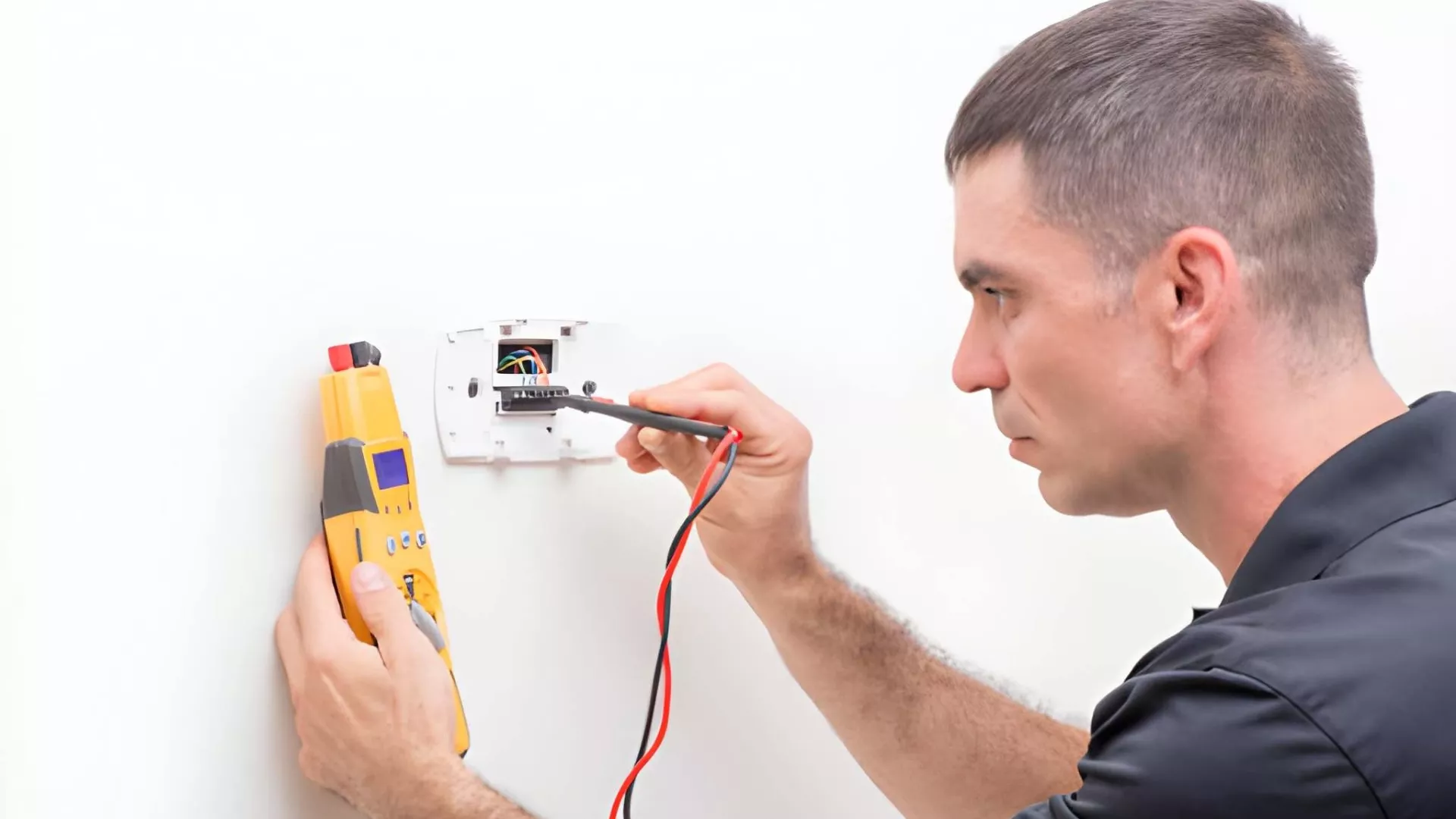
If you are still unsure, a basic multimeter (around $15) gives you a definitive answer in seconds. Set it to AC voltage mode and carefully measure across the two terminals. A reading of approximately 24V = low voltage. A reading of 120V or 240V = line voltage.
The Quickest Visual Clue
Not confident with a multimeter? Use this simple rule of thumb:
- 🏠 Electric baseboard or wall heaters with individual room controls → almost certainly line voltage
- 🌬️ Central forced-air system, heat pump, or boiler → almost certainly low voltage
Pros and Cons of Low Voltage Thermostats
The Advantages
| ✅ Pros | ❌ Cons |
|---|---|
| Very safe — only 24V at the thermostat | Requires transformer (already in most HVAC systems) |
| Precise and responsive temperature control | Slightly higher cost for premium smart models |
| Compatible with virtually all smart platforms | May need C-wire for smart thermostat power |
| Easy multi-zone system setup | Not suitable for direct electric resistance heating |
| DIY-friendly installation for most homeowners | — |
Why Low Voltage Is the Smarter Long-Term Choice
The biggest advantage of low voltage thermostats is their open compatibility with the entire smart thermostat ecosystem. Whether you want a Nest Learning Thermostat, an Ecobee with room sensors, or a manufacturer-branded smart model — all of them run on 24V. This means your investment in a low voltage system keeps paying off as smart home technology continues to evolve.
Additionally, because the thermostat only handles a 24V signal — not full household current — the risk of electrical shock or fire during installation or malfunction is dramatically lower than with line voltage systems.
Pros and Cons of Line Voltage Thermostats
Pros and Cons at a Glance
| ✅ Pros | ❌ Cons |
|---|---|
| Simple, direct control of electric heaters | Limited smart thermostat compatibility |
| Lower upfront unit cost ($25–$60) | Higher electrical load inside the thermostat |
| No transformer or relay needed | Cannot use standard Nest or Ecobee directly |
| Required for baseboard and radiant systems | Licensed electrician often required for installation |
| Reliable and proven technology | Higher shock and fire risk if mishandled |
When Line Voltage Is the Right Choice
Line voltage thermostats are not inferior — they are simply designed for a specific job. If your home uses electric baseboard heaters or radiant floor heating, a line voltage thermostat is the correct and only safe option. Trying to replace it with a standard low voltage smart thermostat without a proper conversion kit is dangerous and will not work.
The good news is that smart line voltage thermostats do exist — brands like Mysa, Cadet, and Stelpro offer Wi-Fi enabled models designed specifically for 120V and 240V systems. So even line voltage homeowners can enjoy app control, scheduling, and energy reports in 2026.
Matching Thermostats to Heating Systems: Baseboard, Furnace, Heat Pump & More
System-by-System Matching Guide
Choosing the wrong thermostat for your heating system is one of the most common — and costly — mistakes homeowners make. Here is a clear, system-by-system guide to get it right the first time:
- 🔵 Central furnace (gas or electric) → Low voltage thermostat (required)
- 🔵 Boiler / hydronic heating → Low voltage thermostat (required)
- 🔵 Heat pump (air-source or ground-source) → Low voltage thermostat (required — often needs heat pump-specific wiring)
- 🔴 Electric baseboard heaters → Line voltage thermostat (required)
- 🔴 Radiant floor heating (electric) → Line voltage thermostat (required)
- 🔴 In-wall electric panel heaters → Line voltage thermostat (required)
- 🟡 Hybrid homes (baseboard + central) → May need both types or a relay conversion kit
What New Construction Data Tells Us
According to 2023 new construction data, 46% of new single-family homes now use heat pumps — all of which require low voltage thermostats. Only around 11% use electric resistance furnaces (line voltage). This confirms that low voltage is the dominant and growing standard in modern residential construction.
“With heat pump adoption accelerating rapidly across North America and Europe, low voltage thermostat systems are becoming the universal standard for new builds. Homeowners with older baseboard systems should seriously consider whether a full system upgrade — not just a thermostat swap — makes financial sense in the long run.” — Sarah Mitchell, Residential Energy Systems Analyst, U.S. Green Building Council
Hybrid Home Scenarios
Some older homes use a combination of central heating and electric baseboard heaters in specific rooms. In these cases, you may need separate thermostats for each system type — or a relay kit (such as the Aube RC840) that allows a low voltage smart thermostat to control a line voltage heating zone. Always consult a licensed HVAC professional for hybrid system setups.
Energy Efficiency, Savings & Cost Comparison
Efficiency Side by Side
| Metric | Low Voltage | Line Voltage |
|---|---|---|
| Point-of-use efficiency | 100% (heat pump: 300–500% COP) | 100% (resistance heating only) |
| Programmable savings | Up to 10% (DOE) | Up to 10% (DOE) |
| Smart thermostat savings | ~8% or $50/year (ENERGY STAR avg.) | Up to 614 kWh/year (~$70) in utility pilots |
| Replacement/install cost (2025) | $200–$450 | $230–$370 |
| Market growth rate | 13.1% CAGR to 2035 | 5.8–5.9% CAGR |
The Heat Pump Efficiency Advantage
Here is the most important efficiency fact in this entire comparison: when a low voltage thermostat controls a heat pump, the system delivers 300–500% efficiency (a Coefficient of Performance of 3–5). That means for every 1 unit of electricity used, you get 3–5 units of heat output.
Line voltage resistance heating, by contrast, delivers exactly 100% efficiency — one unit of electricity in, one unit of heat out. It cannot exceed 100% because it converts electricity directly to heat with no mechanical advantage.
For a home spending $1,500 per year on heating:
- 🔵 Low voltage + heat pump: potential effective cost as low as $300–$500/year with the same heat output
- 🔴 Line voltage + baseboard: stays at $1,500/year with no efficiency multiplier
Smart and Programmable Thermostat Options for Both Types
Low Voltage: The Full Smart Ecosystem
Low voltage systems enjoy full compatibility with virtually every smart thermostat on the market today. Popular options include:
- 🟢 Google Nest Learning Thermostat — AI scheduling, geofencing, energy history
- 🟢 Ecobee SmartThermostat Premium — room sensors, Alexa built-in, detailed energy reports
- 🟢 Honeywell Home T9 — smart room sensors, flexible scheduling
- 🟢 Amazon Smart Thermostat — budget-friendly, Alexa-native
All of these work seamlessly with Alexa, Google Home, Apple HomeKit, and the Matter protocol — giving low voltage homeowners the full smart home experience.
Line Voltage: Specialised Smart Options
Line voltage homeowners are not left behind in 2026. A growing range of smart line voltage thermostats now offers Wi-Fi control, app scheduling, and energy monitoring:
- 🔴 Mysa Smart Thermostat — designed for 240V baseboard heaters, Alexa and Google Home compatible
- 🔴 Cadet SmartStat — Wi-Fi enabled, works with 120V and 240V systems
- 🔴 Stelpro MAESTRO — smart line voltage thermostat with app control and scheduling
Many utility companies now offer rebates of $50–$100 on both low and line voltage smart thermostats under demand-response programmes. Always check your local utility’s website before purchasing to reduce your upfront cost.
Installation, Wiring & Safety Considerations
Low Voltage Installation: DIY-Friendly
Installing or replacing a low voltage thermostat is generally safe and straightforward for confident DIYers. The 24V signal wires carry minimal electrical risk. Follow these basic safety steps:
- Turn off power at the breaker before touching any wires
- Photograph your existing wiring before disconnecting anything
- Label each wire with the terminal it came from (R, G, Y, W, C)
- Connect wires to the matching terminals on your new thermostat
- Restore power and test heating and cooling modes
Line Voltage Installation: Call a Professional
Line voltage thermostat installation is a different matter entirely. Because these systems carry full 120V or 240V household current, incorrect wiring can cause electric shock, equipment damage, or fire. Most states and provinces legally require a licensed electrician for line voltage thermostat work. Do not attempt this as a DIY project unless you are a qualified electrician yourself.
The Critical Safety Warning: Never Mix Types Without a Relay
⚠️ Important Safety Warning: Never connect a low voltage thermostat directly to a line voltage heating circuit — or vice versa — without a proper relay/transformer conversion kit (such as the Aube RC840). Doing so will either cause the thermostat to fail immediately or create a serious fire or shock hazard. When in doubt, always consult a licensed HVAC professional or electrician.
People Also Ask: Line Voltage vs Low Voltage Thermostats
How Do I Know if My Thermostat Is Line Voltage or Low Voltage?
Remove the cover and look at the wires. Low voltage systems have 4–8 thin, coloured wires and a 24V rating on the back label. Line voltage systems have 2 thick wires (black/red or black/white) and a 120V or 240V rating. Baseboard heaters with individual room controls = line voltage. Central furnace or heat pump = low voltage.
Can I Use a Smart Thermostat (Nest/Ecobee) With Line Voltage Heating?
Not directly. Nest and Ecobee are designed for 24V low voltage systems only. For line voltage heating, you need a line-voltage-specific smart thermostat (Mysa, Stelpro, or Cadet) — or a relay conversion kit (Aube RC840) that allows a low voltage smart thermostat to safely control a line voltage heating zone.
Which Is Better — Line Voltage or Low Voltage?
Low voltage is better for 90%+ of homes — offering superior safety, smart thermostat compatibility, and long-term efficiency, especially when paired with a heat pump. Line voltage is the correct choice only when you already have electric baseboard or radiant heating systems that require direct high-voltage switching.
Can I Replace a Line Voltage Thermostat With a Low Voltage One?
No — not without a proper conversion kit. Connecting a 24V thermostat directly to a 120V or 240V circuit will either do nothing or create a dangerous short circuit. You need a transformer and relay kit for safe conversion, or simply replace it with a compatible line voltage smart thermostat instead.
How Much Does It Cost to Install or Replace Each Type?
Based on 2025 data: Line voltage replacement costs $230–$370 (licensed electrician usually required). Low voltage replacement costs $200–$450 (often DIY). Smart thermostat upgrades add $50–$150 to either type but typically pay back within 1–3 years through energy savings and utility rebates.
How to Choose the Perfect Thermostat for Your Home
Your 5-Step Decision Guide
Choosing the right thermostat does not have to be complicated. Follow these five simple steps and you will land on the perfect choice every time:
- 🔍 Identify your heating system type — central furnace, heat pump, boiler, or electric baseboard? This single step eliminates most confusion immediately.
- ⚡ Check your existing wiring and voltage — use the wire-counting method or multimeter test from Section 4 above to confirm line or low voltage.
- 📱 Decide on smart features — do you want remote app control, geofencing, voice control, and energy reports? If yes, low voltage gives you far more options.
- 💰 Factor in your budget and available rebates — check your local utility’s website for smart thermostat rebates of $50–$100 before purchasing.
- 🏷️ Choose a reputable manufacturer — look for UL listing, a minimum 2-year warranty, and active firmware support to protect your investment long-term.
Final Recommendation Table by User Type
| Your Situation | Best Choice | Why |
|---|---|---|
| Central furnace or heat pump | Low Voltage Smart Thermostat | Full smart compatibility, maximum efficiency |
| Electric baseboard heaters | Line Voltage Smart Thermostat | Required by system design — choose Mysa or Stelpro |
| Tight budget, simple needs | Programmable (either type) | Low cost, reliable, no Wi-Fi needed |
| Smart home user (Alexa/Google) | Low Voltage Smart Thermostat | Seamless ecosystem integration |
| Hybrid home (baseboard + central) | Both types or relay conversion kit | Each zone needs its correct voltage type |
| HVAC installer or manufacturer | Low Voltage Platform | Larger market, faster growth (13.1% CAGR), more demand |
The Clear Winner for Most Modern Homes
For the vast majority of homeowners — especially those with central HVAC systems or heat pumps — low voltage thermostats are the clear winner on every measure that matters: safety, smart compatibility, energy efficiency, and long-term value. The market data confirms it: low voltage thermostats hold 48.10% of the total thermostat market and are growing at 13.1% CAGR through 2035 — more than double the growth rate of line voltage systems.
Conclusion: Choose the Right Thermostat and Start Saving Today
What We Learned in This Guide
After covering every angle of the line voltage vs low voltage thermostat debate, here are the key takeaways to remember:
- ✅ Low voltage thermostats (24V) are the standard for central furnaces, boilers, and heat pumps — safer, smarter, and more efficient
- ✅ Line voltage thermostats (120V/240V) are required for electric baseboard and radiant floor heating — simple, direct, and reliable for their intended purpose
- ✅ You cannot swap one type for the other without a proper relay conversion kit — always identify your system first
- ✅ Smart options exist for both types — low voltage opens the full ecosystem; line voltage has dedicated smart models like Mysa and Stelpro
- ✅ Low voltage + heat pump delivers 300–500% efficiency — dramatically outperforming line voltage resistance heating on running costs
- ✅ Utility rebates of $50–$100 are available for smart upgrades on both system types — always check before you buy
