
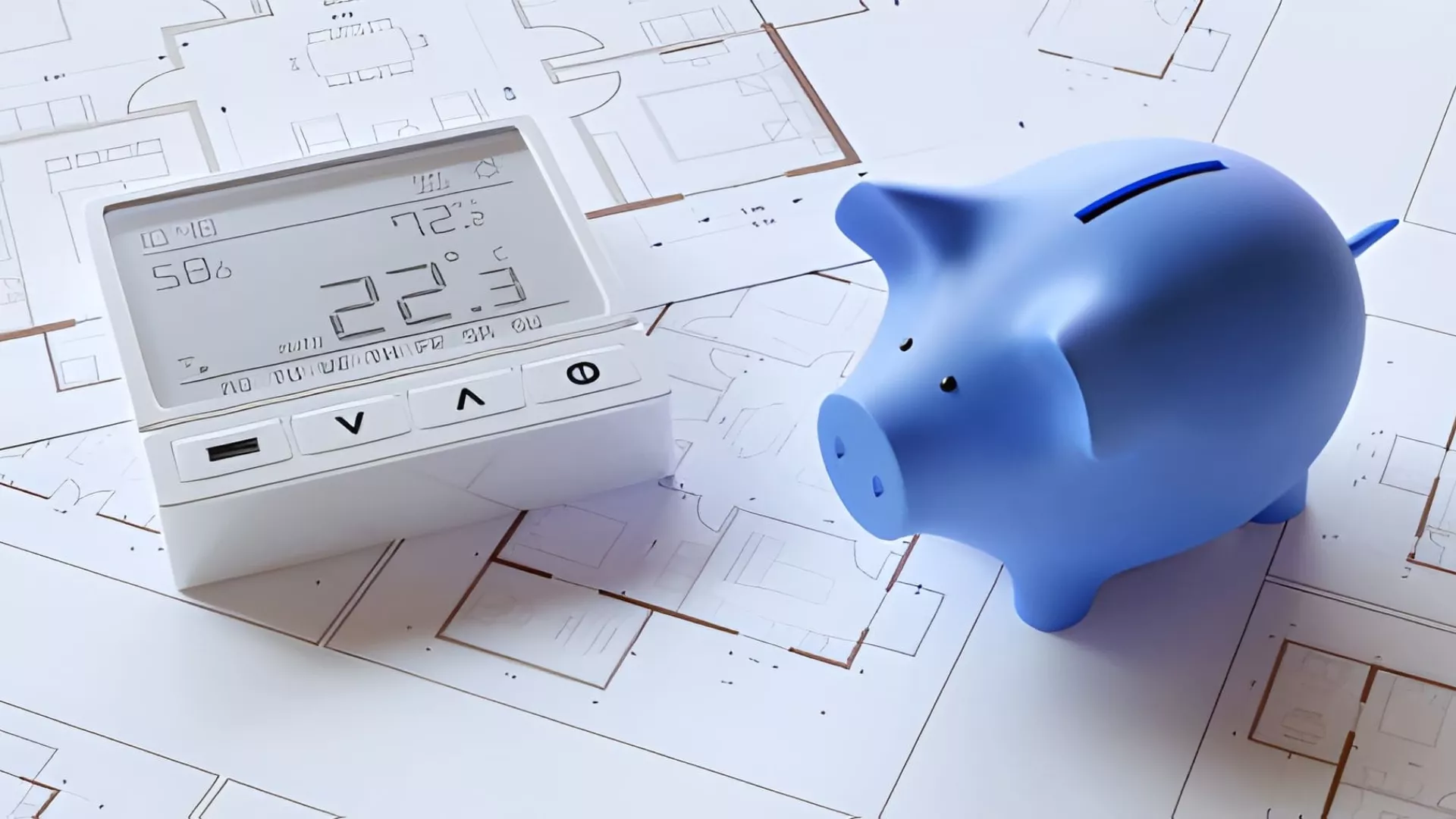
⚡ Quick Answer: How Much Can You Save?
A programmable thermostat saves the average U.S. household up to 10% on heating and cooling bills — roughly $180 per year according to the U.S. Department of Energy and ENERGY STAR. Real 2025 field tests confirm 8–16% savings when programmed correctly. At a purchase price of just $40–$120, most homeowners break even in under 8 months.
Programmable Thermostat Savings: Quick Snapshot
| Scenario | Expected Annual Savings | Notes |
|---|---|---|
| National Average Home | $180/year | DOE / ENERGY STAR benchmark |
| Mild Climate (CA, FL) | 10–12% | Bigger savings in moderate weather |
| Severe Climate (MN, TX) | 5–8% | Smaller indoor/outdoor temp delta |
| 1,500 sq ft home | $140–$200 | Scaled from national average |
| 2,500+ sq ft home | $220+ | Larger HVAC load = bigger savings |
| Winter heating only | 8–10% on heat bill | Common in northern states |
| Summer cooling only | 8–10% on AC bill | Raise temp when away in summer |
🔑 5 Key Takeaways
- The DOE confirms up to 10% savings on heating and cooling — roughly $180/year for the average home
- Every 1°C (1.8°F) setback for 8 hours saves approximately 1% on your energy bill
- Programmable thermostats cost $40–$120 and pay for themselves in under 8 months
- Real 2025 field tests show 8–16% savings when the schedule matches your lifestyle
- Heating and cooling make up nearly 50% of the average home’s energy bill — making this one of the highest-impact upgrades you can make
How Programmable Thermostats Actually Work to Save Energy
The Simple Idea Behind the Savings
A programmable thermostat does one thing really well. It automatically adjusts your home’s temperature based on your daily schedule — so your heating or cooling system is not running full blast when nobody is home or everyone is fast asleep. You set it once, and it handles the rest. Think of it like a smart alarm clock for your HVAC system — it wakes your heating up before you do, and puts it to sleep when you leave.
What Are Setback Periods — and Why Do They Matter?
The biggest energy wins come from what engineers call setback periods. A setback is simply a time when you tell the thermostat to ease off — lower the temperature in winter, or raise it in summer — because you do not need full comfort right now. The most impactful setbacks happen during two windows:
- 🌙 While you sleep — typically 6–8 hours overnight
- 🚪 While you are away — typically 8+ hours during the workday
During these periods, your HVAC system runs far less often. Furthermore, less runtime means less energy consumed — and that shows up directly on your monthly bill.
The Four Daily Periods Explained
Most programmable thermostats let you set four temperature periods per day. Together, these four periods cover your entire daily routine:
- Wake — comfortable temperature as you start your morning
- Leave — setback temperature while the house is empty
- Return — comfortable temperature again as you arrive home
- Sleep — setback temperature overnight while you rest
Heating and cooling account for nearly 50% of the average American home’s energy bill. Therefore, even small reductions in HVAC runtime add up to significant savings across a full year.
Do Programmable Thermostats Really Save Money? The Science Explained
What the U.S. Department of Energy Actually Found
The savings from programmable thermostats are not a marketing claim. They are backed by decades of rigorous testing by the U.S. Department of Energy. The finding is clear and consistent: turning your thermostat back 7–10°C (12–18°F) for 8 hours a day — while you sleep or are away — cuts your annual heating and cooling bill by up to 10%. That is a meaningful reduction that most homeowners can achieve simply by setting a schedule once.
The 1°C Rule: How Every Degree Counts
Here is the simplest way to understand programmable thermostat energy savings. Every 1°C (1.8°F) you set back your thermostat for 8 hours saves approximately 1% on your energy bill. So if you drop your winter heating from 21°C (70°F) to 16°C (61°F) overnight — a 5°C (9°F) setback — you save around 5% just from sleeping. Do the same during the workday, and you are approaching the full 10% DOE figure before the end of the first month.
What Real 2025 Field Tests Show
Recent independent field studies confirm the DOE findings — and in many cases exceed them. Honeywell and Resideo’s 2025 testing showed 8–16% savings in real homes when the programmed schedule matched the household’s actual lifestyle. The key word is “matched” — a schedule that does not reflect how you actually live will underperform. Furthermore, because heating and cooling represent such a large share of total home energy use, even an 8% reduction translates into a noticeable drop on your monthly statement.
“The science behind programmable thermostat savings is some of the most consistent in residential energy efficiency research. The 1% per degree rule holds up remarkably well across different climates, home sizes, and HVAC system types. The only variable that really changes the outcome is whether the homeowner actually programmes the device to match their real schedule — and sticks with it.”
How Much Can You Save? — The Real Numbers
The Headline Figure You Can Count On
The most reliable and widely cited figure for programmable thermostat energy savings comes directly from the U.S. Department of Energy and ENERGY STAR. Their benchmark is straightforward: the average U.S. household saves up to 10% on combined heating and cooling costs — which works out to approximately $180 per year based on national average energy spending. This figure assumes correct programming with meaningful setbacks during sleep and away periods.
What Affects Your Actual Savings
Your real savings will vary based on several factors. However, understanding them helps you set realistic expectations — and in many cases, exceed the average:
- 🏠 Home size — larger homes have bigger HVAC loads, so the same percentage saves more in absolute dollars
- 🌡️ Climate — mild climates often see higher percentage savings because setbacks create a bigger relative change
- 📅 Programming quality — a schedule that matches your real routine delivers the full 10%; a poorly set one delivers far less
- 🔧 HVAC system efficiency — newer, more efficient systems still benefit from setbacks, but the baseline cost is lower
How Programmable Compares to Smart Thermostat Savings
Smart thermostats — the next step up — add geofencing, learning algorithms, and remote app control. In 2025 testing, they averaged 12–23% savings, with some brands claiming up to 26% in ideal conditions. However, a correctly programmed programmable thermostat still hits the full DOE 10% at a fraction of the cost. In monthly terms, $180 per year works out to $15 saved every single month — just from setting a schedule.
Savings Breakdown — Real Data by Climate, Home Size and Season
Why Savings Vary — and What That Means for You
Not every home saves exactly $180 per year — and that is completely expected. Your savings depend on how extreme your local climate is, how large your home is, and how many hours per day it sits empty or everyone is asleep. Interestingly, homeowners in milder climates like California and Florida often see higher percentage savings than those in extreme climates — because the temperature difference between indoors and outdoors is smaller, so reducing HVAC runtime has a proportionally bigger impact on the bill.
Full Savings Breakdown Table
| Scenario | Expected Annual Savings | Source / Notes |
|---|---|---|
| National Average Home | $180 | DOE / ENERGY STAR |
| Mild Climate (CA, FL) | 10–12% | DOE — bigger savings in moderate weather |
| Severe Climate (MN, TX summers) | 5–8% | DOE — smaller indoor/outdoor delta |
| 1,500 sq ft home | $140–$200 | Scaled from national average |
| 2,500+ sq ft home | $220+ | Larger HVAC load = bigger absolute savings |
| Winter heating only | 8–10% on heat bill | Common in northern states |
| Summer cooling only | 8–10% on AC bill | Raise temp when away — same principle |
Source: U.S. Department of Energy, ENERGY STAR, and 2025 Honeywell/Resideo field study data.
Winter vs Summer: The Savings Work Both Ways
Many homeowners focus on winter heating savings — but programmable thermostat energy savings work equally well in summer. In winter, you lower the temperature when away or asleep. In summer, you raise it — letting the house warm up to around 29°C (85°F) while you are out, then cooling it back down before you return. The same 1°C rule applies in both directions. Consequently, homes in hot climates like Texas and Arizona can see significant AC bill reductions simply by programming a higher away temperature during the workday.
Programmable vs Smart Thermostats – Which One Saves More?
The Core Savings Comparison
This is one of the most common questions homeowners ask — and the answer is more nuanced than most articles admit. A correctly programmed programmable thermostat delivers the full DOE 10% savings. A smart thermostat, in 2025 testing, averaged 12–23% savings — a meaningful but not dramatic improvement. The gap narrows considerably when the programmable model is set up properly and the household follows a consistent daily routine.
What Smart Thermostats Add to the Equation
Smart thermostats earn their higher savings through three key features that programmable models cannot match:
- 📍 Geofencing — detects when you leave and arrive, adjusting temperature automatically
- 🧠 Learning algorithms — adapts to your routine over time without manual reprogramming
- 📱 Remote app control — change settings from anywhere when your schedule changes unexpectedly
Brand-Level Savings Data (2025)
| Thermostat Type | Annual Savings | Best For |
|---|---|---|
| Programmable (correctly set) | 8–10% (~$180/year) | Budget-conscious, consistent schedules |
| Nest Learning Thermostat | 12–15% | Hands-off automation lovers |
| Ecobee SmartThermostat | Up to 26% | Multi-room sensing, smart home users |
| Honeywell/Resideo Smart | 8–16% | Reliable all-rounder |
When Programmable Wins — and When to Go Smart
Choose a programmable thermostat if you have a consistent daily routine, want simplicity, and are working with a tight budget. Choose a smart thermostat if you travel frequently, have an irregular schedule, or simply want zero-effort automation. Either way, both types deliver real, meaningful programmable thermostat energy savings — the difference is how much effort you want to put in after installation.
5 Simple Tips to Maximise Energy Savings With Your Programmable Thermostat
Tip 1: Follow the Golden Rule — Set Back 7–10°C
This is the single most impactful thing you can do. Set your thermostat back 7–10°C (12–18°F) during any period when you are away or asleep for 8 or more hours. In winter, drop from your comfortable 21°C (70°F) to around 15–16°C (59–61°F) overnight. In summer, raise from your comfortable 24°C (76°F) to around 29°C (85°F) while you are out. This one change alone delivers the majority of your annual savings.
Tip 2: Use Vacation Mode for Trips
Most programmable thermostats include a one-button vacation or hold mode. When you go away for more than a day, activate it. This keeps the temperature at a safe minimum — typically around 13°C (55°F) in winter to prevent pipe freezing — without running your HVAC unnecessarily for days at a time. Additionally, remember to cancel vacation mode when you return so your normal schedule resumes.
Tip 3: Programme 4–6 Periods Per Day
The more closely your programmed schedule matches your real daily routine, the more you save. Use all four standard periods — Wake, Leave, Return, Sleep — as your foundation. Then add a fifth or sixth period if your weekends differ from weekdays. Most programmable thermostats allow separate weekday and weekend schedules, which is worth using if your Saturday and Sunday routines are different from Monday through Friday.
Tip 4: Placement Matters More Than You Think
Your thermostat can only save energy if it reads the room temperature accurately. Therefore, keep it away from windows, exterior doors, direct sunlight, and supply vents. Any of these can cause false readings — making your HVAC run more or less than it should. An interior wall in a central hallway, at roughly eye height, is almost always the best location for accurate and reliable temperature sensing.
Tip 5: Check Your Filter Every Month
This tip surprises many homeowners — but it is genuinely important. A clogged air filter forces your HVAC system to work harder to push air through your home. Studies show a dirty filter can erase 5–10% of your potential energy savings — effectively cancelling out a large chunk of what your programmable thermostat is working to achieve. Check the filter monthly and replace it every 1–3 months depending on your home’s dust levels and whether you have pets.
✅ Quick-Reference: 5 Tips at a Glance
- Set back 7–10°C (12–18°F) when away or asleep for 8+ hours
- Use vacation/hold mode for any trip longer than one day
- Programme 4–6 periods per day to match your real routine
- Place thermostat on an interior wall away from sun, vents, and drafts
- Replace air filter every 1–3 months — a dirty filter costs you 5–10% in savings
Common Myths About Programmable Thermostat Savings — Busted
Myth 1: Keeping the Temperature Constant All Day Is More Efficient
Myth 2: Programmable Thermostats Do Not Save Anything in Real Life
Myth 3: Smart Thermostats Are the Only Ones Worth Buying
Is It Worth Upgrading? Payback Time and Real-World ROI
The Upfront Cost Is Remarkably Low
One of the most compelling aspects of programmable thermostat energy savings is how little it costs to get started. A reliable programmable thermostat — from brands like Honeywell, Emerson, or White-Rodgers — costs between $40 and $120. Most homeowners can install one themselves in under an hour with a screwdriver and a phone photo of their existing wiring. There is no professional installation fee required in most standard setups.
The Payback Calculation
The maths here is genuinely impressive. At the DOE’s benchmark of $180 in annual savings:
- A $40 thermostat pays for itself in approximately 2–3 months
- A $120 thermostat pays for itself in approximately 7–8 months
- Most homeowners break even well before the end of the first year
Furthermore, many utility companies offer rebates of $50–$100 on programmable and smart thermostat purchases. With a rebate applied, even a $120 model can pay for itself in under 4 months.
Real-World ROI Over 5 Years
| Cost Factor | Low Estimate | High Estimate |
|---|---|---|
| Thermostat purchase price | $40 | $120 |
| Utility rebate (if available) | -$50 | -$100 |
| Net upfront cost | $0 (rebate covers it) | $20 |
| Annual savings | $140 | $220 |
| Payback period | Under 1 month | Under 8 months |
| 5-year net savings | $660–$700 | $880–$980 |
Based on DOE benchmark savings of $140–$220/year depending on home size and climate. Rebate availability varies by utility provider and location.
Who Benefits Most From Upgrading Right Now
The homeowners who see the biggest return from upgrading to a programmable thermostat are those who currently use a manual or non-programmable thermostat — meaning they are leaving money on the table every single day. Additionally, homes in moderate climates with consistent daily routines, and larger homes with higher baseline energy costs, will see the fastest payback and the largest absolute dollar savings. If your current thermostat does not have a scheduling function, upgrading is one of the highest-return home improvements you can make for under $120.
Frequently Asked Questions
Do programmable thermostats actually save energy and money?
Yes — and the evidence is rock solid. The U.S. Department of Energy has tested this for decades across thousands of real homes. Proper setbacks — turning the temperature back 7–10°C (12–18°F) for 8 hours a day — deliver up to 10% savings on annual heating and cooling costs. For the average U.S. household, that works out to approximately $180 per year. Real 2025 field studies from Honeywell and Resideo confirm 8–16% savings in everyday use when the programmed schedule matches how the household actually lives.
How much do programmable thermostats save on average?
The DOE and ENERGY STAR benchmark figure for 2026 is $180 per year — representing approximately 10% of the typical American household’s annual heating and cooling spend. However, your actual savings will vary. Smaller homes in mild climates may save $140–$160. Larger homes or those with higher baseline energy costs can save $220 or more. The quality of your programming — how closely your schedule matches your real daily routine — is the single biggest variable that determines where in that range you land.
Are smart thermostats better than programmable thermostats for saving money?
Smart thermostats generally save a bit more — 12–23% in 2025 tests compared to 8–10% for programmable models. However, the gap is smaller than most people expect. A correctly programmed thermostat hits the full DOE 10% at a much lower upfront cost. The real advantage of smart thermostats is convenience and automation — geofencing, learning, and remote control mean you do not need to think about programming at all. Choose programmable if you want simple and cheap. Choose smart if you want zero effort and are comfortable with a higher upfront investment.
How do I programme my thermostat to save the most energy?
Follow this simple four-period framework for maximum programmable thermostat energy savings:
- ⏰ Wake — set a comfortable temperature as you start your morning (e.g. 20–21°C / 68–70°F in winter)
- 🚪 Leave — set back 7–10°C (12–18°F) while the house is empty during the day
- 🏠 Return — restore comfortable temperature 30 minutes before you arrive home
- 🌙 Sleep — set back again overnight for 6–8 hours of setback savings
Test the schedule for one full billing cycle and then tweak based on your actual comfort and the savings you see on your statement.
What temperature should I set my programmable thermostat for maximum savings?
These are the DOE-recommended settings for maximum programmable thermostat energy savings:
- ❄️ Winter — awake and home: 20–21°C (68–70°F)
- ❄️ Winter — asleep or away: 15–16°C (59–61°F)
- ☀️ Summer — awake and home: 25–26°C (78°F)
- ☀️ Summer — away: 29°C (85°F) or higher
Remember — every 1°C (1.8°F) you shift for 8 hours saves approximately 1% on your bill. The bigger the setback, the bigger the saving.
Do programmable thermostats work in summer too?
Absolutely — and summer is often where the biggest savings appear. Raising your thermostat setting by 7–10°C (12–18°F) when you leave for work in summer works on exactly the same principle as lowering it in winter. Your AC runs far less during the hottest part of the day — when electricity rates are often at their peak. Many homeowners in warm climates like Texas, Arizona, and Florida report that their summer AC savings actually exceed their winter heating savings simply because air conditioning costs so much more to run per hour than a gas furnace.
Conclusion
The Bottom Line on Programmable Thermostat Energy Savings
The answer to the question this article started with is clear. A programmable thermostat can really save — and the numbers are backed by decades of real data. Up to 10% on your annual heating and cooling bills. Around $180 per year for the average home. A payback period of under 8 months in most cases. And a 5-year net return of $700–$900 after the purchase price.
The technology itself is simple. The science behind it is solid. The only thing standing between most homeowners and these savings is taking 20 minutes to set a schedule that matches how they actually live. A setback of 7–10°C (12–18°F) while you sleep and while you are away is all it takes to unlock the full DOE benchmark savings — starting from the very first billing cycle after installation.
Furthermore, if you are currently using a manual thermostat with no scheduling function, upgrading is one of the easiest, cheapest, and fastest-payback home improvements available to you right now. Check your utility company’s website for rebates before you buy — many offer $50–$100 back, which can bring your net cost close to zero.
