
⚡ Quick Answer: Radiant Floor vs Forced Air at a Glance
| Feature | Radiant Floor | Forced Air |
|---|---|---|
| Heat-Up Speed | 30–60 min to feel warmth | Minutes from start |
| Energy Efficiency | 20–40% more efficient | Baseline reference |
| Air Quality | No dust circulation | Circulates allergens |
| Upfront Cost | $14,000–$35,000 | $5,000–$18,000 |
| Noise Level | Silent | Audible blower noise |
| Cooling Capability | Heating only (mostly) | Heating + cooling |
| Best For | New builds, allergy sufferers | Retrofits, tight budgets |
💡 Bottom line: Radiant floor wins on efficiency and comfort. Forced air wins on speed and upfront cost. Many homeowners combine both for the best result.
Choosing between radiant floor heating and forced air is one of the biggest decisions you will make for your home’s comfort and energy costs. Therefore, this guide lays out everything you need to know — simply and clearly — so you can make the right call for your home and budget.
Radiant Floor vs Forced Air — The Basics
How Radiant Floor Heating Works
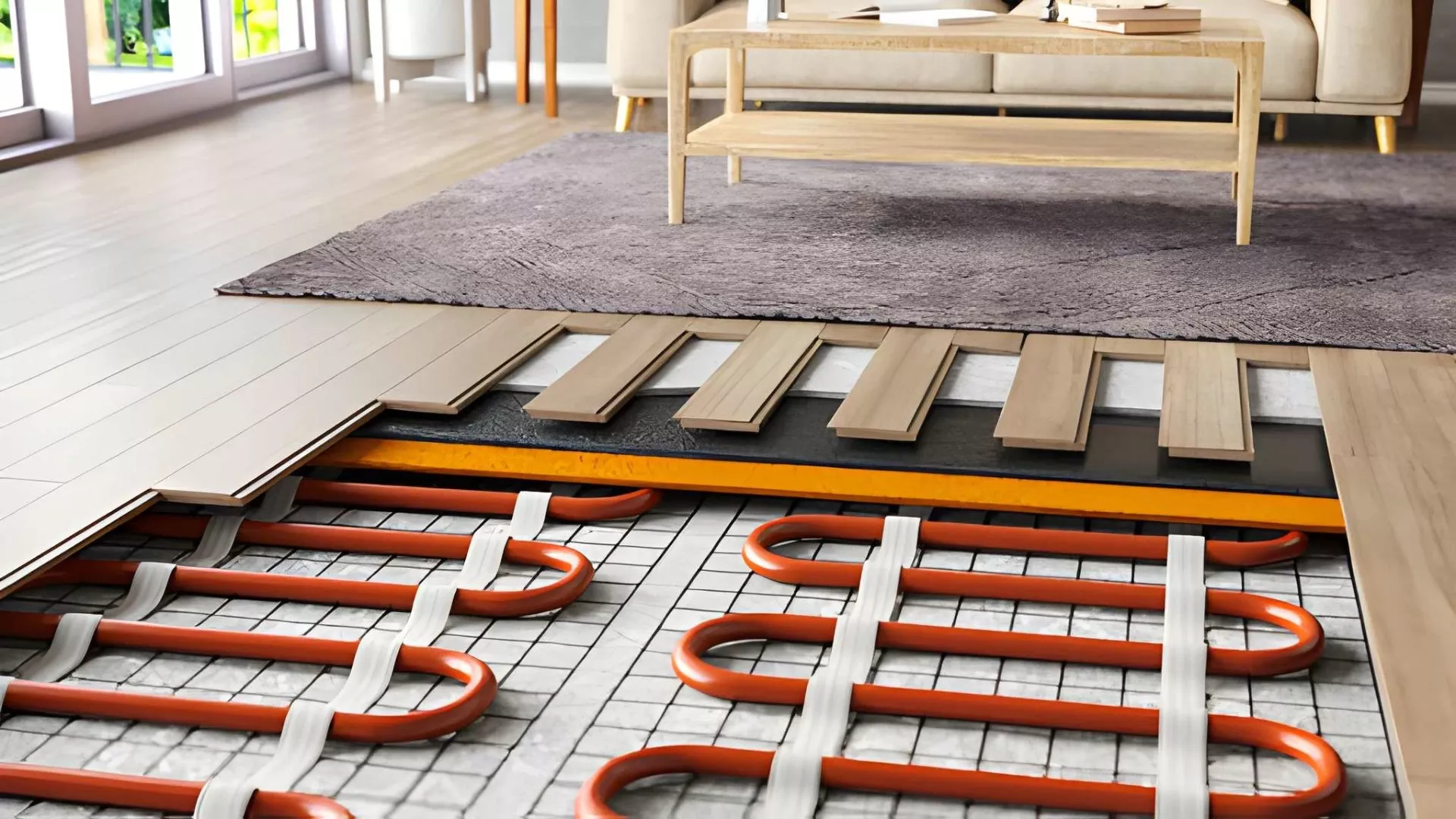
Radiant floor heating warms your home by sending heat directly through the floor surface. There are two main types:
- Electric radiant: Thin heating mats or cables are installed beneath the floor surface. They are ideal for smaller areas like bathrooms and kitchens, and they connect directly to your home’s electrical system.
- Hydronic radiant: Warm water is pumped through a network of tubing installed beneath the floor. This is the most energy-efficient option and is commonly used for whole-home heating, powered by a boiler or heat pump.
In both cases, the heat rises naturally from the ground upward — warming your floors, furniture, walls, and the people in the room first. Think of it like standing in sunlight — you feel the warmth directly on your body, not just in the air around you.
How Forced Air Heating Works
Forced air is the most common heating system in North American homes. A furnace or heat pump heats the air, and a blower fan pushes that heated air through a network of ducts and out through vents in your floors, walls, or ceilings.
Forced air systems are popular because they are versatile — the same duct network that delivers heat in winter can deliver cooled air from an air conditioner in summer. Furthermore, they are faster to heat a space and generally cheaper to install when ductwork already exists in the home.
The Core Difference in One Sentence
Which Heats Faster — Radiant Floor or Forced Air?
Forced Air — Speed Champion
When it comes to raw speed, forced air wins clearly. Once your thermostat calls for heat, the furnace or heat pump fires up and the blower begins pushing warm air through the vents within minutes. You can feel the difference in room temperature very quickly — which is why forced air works so well for homes where temperatures drop suddenly or where heating needs change throughout the day.
This speed advantage also makes forced air a strong choice for homes in climates with unpredictable cold snaps, where you need the temperature to recover fast — for example, coming home to a cold house after a weekend away.
Radiant Floor — Slow but Steady
Radiant floor heating works very differently. Because the heat must travel through the thermal mass of the floor — whether that is concrete, tile, or wood — it takes 30–60 minutes before you notice warmth underfoot, and up to 2–3 hours for the full room to reach your target temperature.
However, this is not necessarily a disadvantage. Once a radiant floor system reaches temperature, it holds that warmth far longer than forced air. The floor acts like a giant storage heater — continuing to radiate warmth even after the system cycles off. As a result, temperature fluctuations are minimal and the room feels consistently comfortable throughout the day.
Which Speed Is Right for Your Lifestyle?
Quick Decision Guide:
- 🏃 You need fast heat on demand → Forced air is your system
- 🏡 You want consistent comfort all day → Radiant floor is your system
- ⏰ You use a smart thermostat with scheduling → Radiant’s slow warm-up becomes a non-issue with pre-programmed timing
Energy Efficiency and Savings
Why Radiant Floor Is More Efficient
Radiant floor heating is 20–40% more energy-efficient than forced air — and there are two main reasons why this gap exists.
First, forced air systems lose a significant amount of energy through their duct networks. According to the U.S. Department of Energy, duct losses account for up to 30% of total heating energy in a typical forced-air home — meaning nearly a third of what you pay to heat your home escapes before it ever reaches the living space.
Radiant systems have no ducts at all. Every unit of energy produced goes directly into warming your floor and your home — with virtually zero distribution loss.
Second, radiant heating lets you feel comfortable at lower thermostat settings. Because radiant warms your body directly rather than just the air, most people feel equally comfortable at 19°C (66°F) with radiant heat compared to 21°C (70°F) with forced air. That 2–4°C (3–7°F) difference in thermostat setting translates directly into lower energy bills every month.
“Our research across more than 400 buildings consistently shows that radiant systems outperform forced-air on efficiency — particularly in well-insulated new construction. The elimination of duct losses alone is worth 20–30% in energy savings for most homes.”
Annual Savings Comparison Table
| Scenario | Annual Savings vs Forced Air |
|---|---|
| New construction (radiant vs forced air) | $600–$1,200 per year |
| Retrofit installation in cold climate | $200–$800 per year |
| Average U.S. home (2,000 sq ft) | 20–40% lower heating bills |
In real monthly terms, a 2,000 sq ft home heated with radiant floor typically costs $120–$180 per month to run, compared to $150–$220 per month with forced air — a meaningful difference that compounds significantly over the years.
Comfort and Air Quality — Which Feels Better Day to Day?
Radiant Floor Comfort — Warm Feet, No Drafts
Ask anyone who has lived with radiant floor heating and the answer is almost always the same — it simply feels better. The warmth rises evenly from the floor upward, which means the temperature at floor level (where your feet are) is comfortable, while the air near the ceiling stays slightly cooler. This matches the human body’s natural comfort preferences perfectly.
With forced air, the opposite often happens. Hot air rises to the ceiling first, leaving feet and ankles cooler — especially on cold winter mornings. Additionally, forced air creates noticeable air movement as the blower runs, which many people find uncomfortable or drafty during cold weather.
Radiant systems also run in complete silence. There are no blower fans, no duct rumbles, and no clicking registers — just quiet, steady warmth throughout your home.
Air Quality Comparison
This is one of the most significant — and often overlooked — differences between these two systems.
Forced air systems are essentially large air-moving machines. Every time the blower runs, it circulates whatever is in your ductwork — dust, pet dander, pollen, mould spores, and other allergens — throughout every room in your home. Even with high-quality filters, some particles always get through.
Radiant floor heating moves no air at all. There are no ducts to harbour allergens, no blowers to spread them, and no vents to collect dust. As a result, the air in a radiant-heated home is noticeably cleaner — and humidity levels are better maintained, since forced air tends to dry out the air as it heats it.
Who Benefits Most from Radiant Comfort?
- 🤧 Allergy and asthma sufferers — no allergen circulation is a genuine health benefit
- 👶 Families with young children — warm floors are safer and more comfortable for babies and toddlers
- 🥶 Cold climate homeowners — even, consistent warmth eliminates the cold-spot problem common with forced air
- 🦮 Pet owners — pets spend most of their time at floor level, where radiant heat is strongest
“From an indoor air quality standpoint, radiant floor systems offer a clear advantage for allergy-prone households. The absence of forced air movement means allergen levels in the living space are measurably lower — particularly for dust mite particles and pet dander.”
Installation and Operating Costs
Upfront Installation Costs
[📸 Product image carousel: Insert 2–3 product photos here with captions, e.g., “Electric Radiant Floor Mat — ideal for bathrooms and kitchens”, “Hydronic Radiant Tubing System — whole-home efficiency”, “Forced Air Furnace with Smart Thermostat — fast and affordable”]
| Feature | Electric Radiant | Hydronic Radiant | Forced Air |
|---|---|---|---|
| Installed Cost / sq ft | $8–$15 | $6–$20 | $4–$8 |
| Whole Home (2,000 sq ft) | $14,000–$30,000 | $15,000–$35,000 | $5,000–$18,000 |
| Daily Op Cost (100 sq ft) | $0.15–$0.35 | $0.15–$0.35 | $2.00–$4.00 |
| Payback Period | 5–10 years | 2–5 years | Baseline |
Daily Operating Costs and Payback Period
The daily operating cost difference is striking. Running radiant floor heating over 100 sq ft costs just $0.15–$0.35 per day — compared to $2.00–$4.00 per day for the equivalent forced air coverage. Over a full heating season, that difference adds up to thousands of dollars.
For new construction, hydronic radiant systems typically pay back their higher installation cost within 2–5 years through energy savings alone. Electric radiant takes slightly longer at 5–10 years — but still delivers consistent savings and comfort benefits for the life of the home.
Pros and Cons — Head-to-Head Comparison
Radiant Floor Heating — Pros and Cons
[📸 Product image carousel: Insert 2–3 radiant floor thermostat or system photos with captions, e.g., “Radiant Floor Thermostat with Floor Sensor — precise comfort control”, “Hydronic Radiant System Controller — whole-home zoning”]
- ✅ 20–40% more energy-efficient than forced air — lower monthly bills
- ✅ Even, consistent warmth from the floor up — no cold spots or drafts
- ✅ Completely silent operation — no blower noise, no duct rumble
- ✅ Superior air quality — no allergen or dust circulation
- ✅ Comfortable at lower thermostat settings — 19°C (66°F) feels like 21°C (70°F) with forced air
- ✅ Longer heat retention — floor stays warm after system cycles off
- ❌ Higher upfront installation cost — $14,000–$35,000 for a whole home
- ❌ Slow to respond — 30–60 minutes before warmth is felt underfoot
- ❌ No built-in cooling — a separate cooling system is required for summer
- ❌ Harder to retrofit — floor removal is typically required in existing homes
Forced Air Heating — Pros and Cons
- ✅ Lower upfront cost — especially when ductwork already exists
- ✅ Fast heat-up time — warm air reaches the room within minutes
- ✅ Integrated heating and cooling — one system handles all seasons
- ✅ Easy to retrofit — straightforward upgrade for most existing homes
- ✅ Wide technician availability — any qualified HVAC tech can service it
- ❌ Up to 30% duct energy loss — significant efficiency drain
- ❌ Uneven temperatures — hot near vents, cooler elsewhere
- ❌ Circulates allergens and dust — problematic for allergy sufferers
- ❌ Audible blower noise — noticeable when the system cycles
- ❌ Dries out indoor air — may require a humidifier in winter
Quick Verdict
For new construction or full renovations, radiant floor heating is the superior choice for comfort, efficiency, and long-term savings. For existing homes with ductwork on a budget, forced air remains a practical and effective solution — particularly when upgraded with a smart thermostat to recover as much efficiency as possible.
Smart Thermostats and Zoning — Unlocking Maximum Savings
How Smart Thermostats Transform Both Systems
Regardless of which heating system you choose, pairing it with a smart thermostat delivers meaningful additional savings — typically 10–20% on top of the system’s baseline efficiency. Smart thermostats achieve this by learning your schedule, automatically reducing heat when you are away or asleep, and responding faster and more precisely to temperature changes than a manual thermostat ever could.
Both radiant and forced air systems support zoning — the ability to control temperatures independently in different areas of your home. With zoning, you can keep the living room at 21°C (70°F) during the day while setting unused bedrooms to 17°C (63°F), saving energy in spaces that do not need full heating.
Radiant Floor and Smart Thermostat — The Perfect Pairing
Radiant floor heating benefits especially from smart thermostat control — specifically from thermostats that include a floor temperature sensor. Because radiant systems are slow to respond, a smart thermostat can pre-schedule heat-up times so your floor is already warm when you wake up — eliminating the slow warm-up disadvantage entirely.
Floor sensors also prevent overheating, which protects certain floor types (especially hardwood) from heat damage while maintaining maximum comfort. Furthermore, precise scheduling means the system only heats when and where it is needed — maximising the already-impressive efficiency of radiant heating.
Forced Air and Smart Thermostat — Still a Big Upgrade
For forced air systems, smart thermostats work alongside motorised damper systems to create true zone control — opening and closing dampers in the ductwork to direct airflow only where it is needed. This combination can recover a significant portion of the efficiency that duct losses normally cost.
Which System Is Right for Your Home?
Choose Radiant Floor Heating If You…
- ✅ Are building a new home or undertaking a major renovation with floor replacement
- ✅ Live in a cold climate where consistent, long-lasting warmth is a priority
- ✅ Suffer from allergies or asthma and want cleaner indoor air
- ✅ Value silent, draft-free comfort and are willing to pay more upfront
- ✅ Want the lowest long-term operating costs and are planning to stay in your home for 5+ years
- ✅ Have young children or pets who spend time on the floor
Choose Forced Air Heating If You…
- ✅ Already have existing ductwork and want the most cost-effective upgrade
- ✅ Are on a tight budget and need whole-home heating for under $18,000
- ✅ Need a system that handles both heating and cooling through a single installation
- ✅ Want fast heat recovery — especially useful in climates with sudden cold snaps
- ✅ Own a rental property where simplicity and low maintenance matter most
The Best of Both — Hybrid Approach
Many homeowners are discovering that the best answer is not one system or the other — it is both, used strategically. A popular hybrid approach combines radiant floor heating in high-comfort areas (bathrooms, kitchens, master bedrooms) with a forced air system handling the rest of the home and all summer cooling.
This approach gives you the luxury warmth of radiant exactly where you want it most — stepping onto a warm bathroom floor on a cold morning — while keeping installation costs manageable and retaining the flexibility of forced air for whole-home temperature control and cooling. Furthermore, a single smart thermostat system can coordinate both, scheduling each zone independently for maximum efficiency.
People Also Ask — Quick Answers
Is radiant floor heating more efficient than forced air?
Yes — radiant floor heating is 20–40% more energy-efficient than forced air, according to Lawrence Berkeley National Laboratory research across 400+ buildings. The main reasons are the elimination of duct energy losses (up to 30% in forced air systems) and the ability to maintain comfort at lower thermostat settings — typically 19°C (66°F) with radiant vs 21°C (70°F) with forced air.
Which is cheaper to install — radiant floor or forced air?
Forced air is significantly cheaper to install upfront — typically $4–$8 per sq ft compared to $8–$20 per sq ft for radiant floor systems. For a 2,000 sq ft home, forced air costs $5,000–$18,000 installed, while radiant floor ranges from $14,000–$35,000. However, radiant’s lower operating costs typically pay back the difference within 2–10 years depending on the system type and climate.
Does radiant floor heating save money on energy bills?
Yes — consistently. Homeowners switching from forced air to radiant floor heating typically save $600–$1,200 per year in new construction, and $200–$800 per year in cold-climate retrofits. Monthly running costs for a 2,000 sq ft radiant home average $120–$180, compared to $150–$220 for forced air. Over a 15-year system lifespan, total savings can reach $9,000–$18,000.
Is radiant heat better for allergies than forced air?
Yes — radiant floor heating is significantly better for allergy sufferers. Because radiant systems move no air, they do not circulate dust, pollen, pet dander, or mould spores through your living space the way forced air duct systems do. Indoor air quality in radiant-heated homes is measurably cleaner, and humidity levels are better maintained — both important factors for allergy and asthma management.
How long does radiant floor heating take to warm a room?
Radiant floor heating typically takes 30–60 minutes before you notice warmth underfoot, and 2–3 hours to bring a full room to target temperature — because the heat must travel through the thermal mass of the floor before it radiates into the room. However, once warm, radiant holds temperature far longer than forced air — and a smart thermostat with pre-scheduling eliminates the slow warm-up entirely by starting the system before you need it.
Conclusion
Radiant Floor vs Forced Air — The Final Verdict
Both radiant floor heating and forced air have earned their place in modern homes — and the right choice depends entirely on your specific situation. Radiant floor heating is the clear winner for comfort, air quality, and long-term energy efficiency — delivering 20–40% lower heating bills, silent operation, and cleaner indoor air that forced air simply cannot match. If you are building a new home or undertaking a major renovation, the investment in radiant is almost always worth it over a 5–10 year horizon.
Forced air remains a practical, proven, and cost-effective choice for existing homes with ductwork, tight budgets, or anyone who needs a single system to handle both heating and cooling. When paired with a modern smart thermostat, a forced air system can recover significant efficiency and deliver comfortable, well-controlled temperatures throughout the year.
