
⚡ Quick Answer: Star vs Bus Topology at a Glance
Bottom line: For almost every network in 2025, star topology is the clear winner — it is faster, more reliable, easier to manage, and scales with your needs. Bus topology is largely retired and only makes sense for tiny, temporary, or ultra-low-budget setups.
| Feature | ⭐ Star Topology | 🚌 Bus Topology |
|---|---|---|
| Layout | Devices connect to a central switch | Devices share one backbone cable |
| Performance | ✅ High — dedicated connections | ❌ Drops as devices increase |
| Reliability | ✅ One failure = one device down | ❌ One failure = whole network down |
| Scalability | ✅ Add ports easily | ❌ Hard to expand |
| Upfront Cost | 💰 Moderate | 💰 Very low |
| Best For | Homes, offices, businesses | Tiny or temporary setups only |
1. What Is Bus Topology?
The Basic Idea
Imagine a long hallway in a school. Every classroom door opens into that same hallway. If someone blocks the hallway, nobody can get through. That is exactly how bus topology works.
In a bus topology, every device connects to one single shared cable — called the “backbone” or “bus.” Data travels along this cable in both directions. Every device on the network receives every signal, even if the message was not meant for them.
How It Works
- A single coaxial or twisted-pair cable runs through all devices
- Terminators sit at both ends of the cable to stop signals from bouncing back
- All devices share the same communication channel
- Only one device can send data at a time — otherwise, signals crash into each other (called a collision)
A Quick History Note
Bus topology was the original Ethernet design back in the 1980s and 1990s (known as 10BASE2). It was popular because it was cheap and simple. However, as networks grew bigger, its weaknesses became impossible to ignore. Today, it is largely considered a legacy technology.
2. What Is Star Topology?
The Basic Idea
Now imagine a post office. Every letter goes to the post office first, and then the post office sends it to the right address. That is star topology in a nutshell.
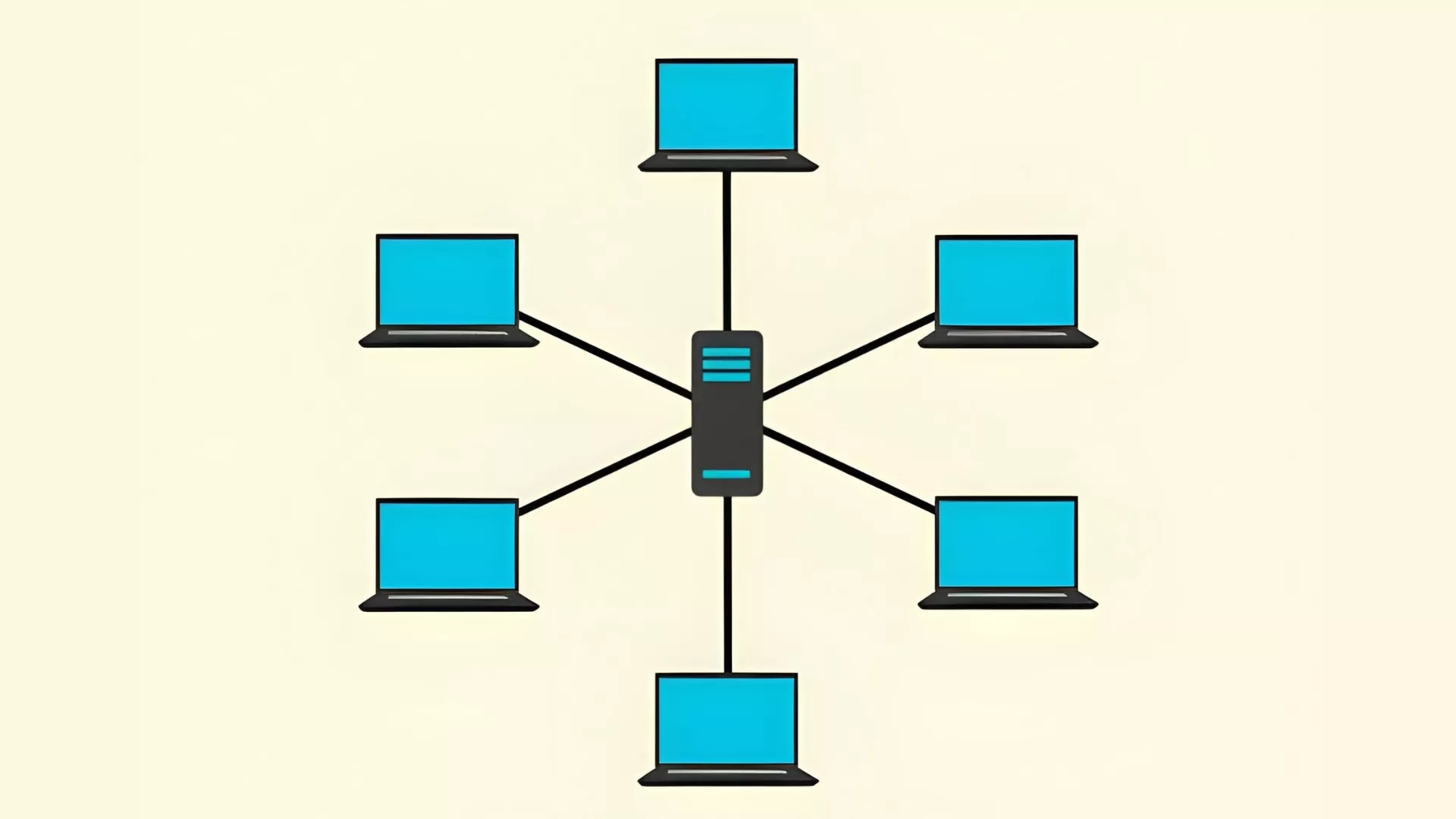
In a star topology, every device connects directly to a central switch. The switch acts like the post office — it receives data and sends it only to the correct device. This makes the network much smarter and faster.
How It Works
- Each device has its own dedicated cable running to the central switch
- The switch manages all traffic and creates point-to-point connections
- Modern switches eliminate collisions entirely — no more data crashes
- If one cable breaks, only that one device goes offline — the rest keep working
Why Star Topology Dominates Today
Star topology is the standard for virtually every modern network — from your home Wi-Fi router to massive corporate data centres. The shift from hubs to smart switches made star topology even more powerful, giving each device its own dedicated bandwidth. According to a 2025 industry report, Industrial Ethernet (predominantly star/switched architecture) accounted for 76% of new node installations, up from 65% in 2022.
“The switched star topology is the undisputed workhorse of modern LANs. Its ability to isolate faults and scale on demand makes it the only sensible choice for any network expected to grow beyond a handful of devices.”
3. Key Differences Between Star and Bus Topology
Side-by-Side Visual Comparison
Detailed Comparison Table
| Feature | Star Topology | Bus Topology |
|---|---|---|
| Physical Layout | Individual cables from each device to central switch | One continuous backbone cable |
| Data Flow | Intelligent routing — sent only to target device | Broadcast to all devices on the cable |
| Single Point of Failure | Central switch (mitigated with redundancy) | The backbone cable itself |
| Scalability | Easy — just add a port or new switch | Hard — performance drops with each new device |
| Collision Handling | Collision-free with modern switches | CSMA/CD required — collisions are frequent |
The Most Important Difference
The biggest difference between star and bus topology comes down to this: in a bus network, one problem affects everyone; in a star network, one problem affects only one device. Furthermore, star topology routes data intelligently, while bus topology simply shouts the message to everyone and hopes the right device is listening.
4. Advantages and Disadvantages of Bus Topology
✅ Advantages of Bus Topology
- Very low cost — you only need one cable and minimal hardware
- Simple to set up — even a beginner can install it quickly
- Less cabling needed — great for very small or temporary setups
- Easy to understand — the concept is straightforward for learning purposes
❌ Disadvantages of Bus Topology
- One cable break = total network failure — the entire network goes down
- Performance gets worse as you add devices — more devices mean more collisions
- Very difficult to troubleshoot — finding a fault on a long cable is time-consuming
- Poor scalability — it simply was not designed to grow
- High packet loss in busy networks due to constant collisions
💡 Is Bus Topology Still Used in 2025?
Rarely. Bus topology has been largely retired from mainstream use. You might still find it in old educational labs, legacy coaxial Ethernet installations, or extremely small temporary setups where cost is the only concern. For any new network, it is not recommended.
5. Advantages and Disadvantages of Star Topology
✅ Advantages of Star Topology
- Excellent fault isolation — if one cable or device fails, only that device is affected
- Easy to troubleshoot — you can quickly identify which device or cable has a problem
- Highly scalable — simply add more ports or connect another switch
- Dedicated bandwidth per device — no sharing, no collisions, consistent speed
- Centralised management — security rules and monitoring are all handled at the switch
❌ Disadvantages of Star Topology
- Higher upfront cost — you need more cable and a quality switch
- Central switch is a single point of failure — though this is easily solved with a backup switch
- More hardware required — initial setup is more involved than bus
💡 Why Does Star Topology Dominate Modern Networks?
Because reliability and speed matter more than upfront savings. A single network outage can cost a business thousands of dollars in lost productivity. Star topology’s fault isolation and scalability make it the smarter long-term investment — and that is exactly why it powers the vast majority of modern Ethernet networks worldwide.
6. Performance, Reliability, and Scalability: Head-to-Head Comparison
Performance
Star topology delivers consistent, high-speed performance because each device gets its own dedicated connection to the switch. There is no sharing, and therefore no slowdowns caused by other devices. In contrast, bus topology forces all devices to share the same cable. As a result, the more devices you add, the more collisions occur, and the slower the entire network becomes.
Reliability
Star topology is significantly more reliable. Because each device has its own cable, a single failure only takes down that one device. The rest of the network keeps running smoothly. On the other hand, bus topology has a critical weakness — if the backbone cable breaks at any point, the entire network fails immediately. There is no workaround.
Scalability
Growing a star network is straightforward. You simply plug a new device into an available switch port, or add another switch. Bus topology, however, was never built to scale. Adding more devices degrades performance, and eventually the network becomes so congested it is practically unusable.
Scoring Summary
| Category | Star Topology | Bus Topology |
|---|---|---|
| Performance | ⭐⭐⭐⭐⭐ | ⭐⭐ |
| Reliability | ⭐⭐⭐⭐⭐ | ⭐ |
| Scalability | ⭐⭐⭐⭐⭐ | ⭐ |
7. Cost Analysis: Star vs Bus Topology
Upfront Costs
Bus topology wins on initial cost — no question. You only need one cable and two terminators. There is no switch to buy, and the setup takes minutes. For a tiny temporary network with two or three devices, this can be appealing.
Star topology, however, requires individual cables for each device plus a switch. A basic unmanaged switch starts at around $20–$50 USD for home use, while enterprise-grade managed switches can cost significantly more.
Long-Term Total Cost of Ownership
Here is where star topology wins decisively. Consider the hidden costs of bus topology:
- Downtime costs — one cable break shuts everything down
- Troubleshooting time — finding a fault on a long cable takes hours
- Replacement costs — the whole network may need rewiring to expand
Cost Comparison Table
| Cost Factor | Star Topology | Bus Topology |
|---|---|---|
| Initial Setup | Moderate (switch + cables) | Very Low (one cable) |
| Maintenance | Low (easy to diagnose) | High (hard to trace faults) |
| Expansion | Low (add a port or switch) | High (may need full rewire) |
| Long-Term TCO | ✅ Lower overall | ❌ Higher overall |
In 2025 enterprise environments, the total cost of ownership clearly favours star topology. The savings from reduced downtime, easier maintenance, and flexible expansion far outweigh the higher initial investment.
8. Real-World Applications and 2025–2026 Industry Statistics
Where Bus Topology Still Appears
Bus topology is mostly a thing of the past. Today, you might still find it in:
- Old educational labs that have not updated their equipment
- Legacy coaxial Ethernet installations from the 1990s
- Ultra-budget temporary setups with only two or three devices
In short, if you encounter bus topology in the real world, it is almost certainly an old system that has not been upgraded yet.
Where Star Topology Dominates
Star topology, on the other hand, is everywhere:
- Home networks — your router is the central switch
- Office LANs — every desk connects to a switch in the server room
- Schools and universities — campus networks rely on switched star architecture
- Data centres — enterprise-grade star networks power the internet
- Retail and hospitality — point-of-sale systems, Wi-Fi access points, and more
2025–2026 Adoption Statistics
| Topology | 2025–2026 Status | Key Trend |
|---|---|---|
| Star | ✅ Dominant — most common LAN | 76% of new industrial Ethernet nodes in 2025 (up from 65% in 2022) |
| Bus | ❌ Legacy — nearly obsolete | Only in legacy or temporary setups; phased out industry-wide |
“Switched Ethernet in a star configuration has become so universal that specifying any other topology for a new LAN installation today would require extraordinary justification.”
9. Security, Maintenance, and Troubleshooting Considerations
Security: Star Wins Clearly
Star topology gives you centralised control over your entire network. Because all traffic passes through the switch, you can:
- Set up access controls to decide who can connect
- Use VLANs to segment sensitive data from general traffic
- Monitor all traffic from one central point
- Reduce eavesdropping risk — switches send data only to the intended device, unlike bus which broadcasts to everyone
Bus topology, by contrast, broadcasts every message to every device on the network. This means any device can potentially intercept data meant for another device — a serious security risk in any professional environment.
Maintenance: Easier with Star
Maintaining a star network is straightforward. Because each device has its own cable, you can swap out a faulty cable or device without touching the rest of the network. Most modern switches also have indicator lights that immediately show you which port has a problem.
With bus topology, maintenance is a nightmare. A fault anywhere on the backbone cable affects the entire network, and finding the exact location of a break can take hours of manual testing.
Troubleshooting: Star Is Far Faster
| Scenario | Star Topology | Bus Topology |
|---|---|---|
| One device stops working | Check that device’s cable or port | Check entire backbone cable |
| Whole network goes down | Check the central switch | Could be anywhere on the cable |
10. Star vs Bus Topology: Which One Should You Use?
The Simple Decision Framework
By now, the answer is fairly clear. However, to make your decision even easier, here is a straightforward framework to follow. Simply ask yourself these questions, and you will know exactly which topology suits your needs.
🔍 Quick Decision Flowchart
Step 1: Do you need more than 3 devices on your network?
→ Yes → Use Star Topology
→ No → Go to Step 2
Step 2: Is this a permanent or long-term network?
→ Yes → Use Star Topology
→ No → Go to Step 3
Step 3: Does network downtime cost you money or productivity?
→ Yes → Use Star Topology
→ No → Go to Step 4
Step 4: Is this a tiny, one-off, ultra-budget temporary setup with 2–3 devices only?
→ Yes → Bus Topology may work
→ Any doubt at all → Use Star Topology
✅ Choose Star Topology If…
- You are setting up a home, office, school, or business network
- You need your network to grow over time
- You cannot afford unexpected downtime
- You need fast, consistent speeds for multiple devices
- You want easy troubleshooting and centralised security
- You are building any new network in 2025 or beyond
🚌 Choose Bus Topology If…
- You have an extremely tight budget and only 2–3 devices
- The network is completely temporary — for example, a one-day event
- You are setting up a learning lab purely to study legacy networking concepts
- Growth and reliability are not concerns at all
🏆 The 2025 Verdict
Star topology is the right choice for virtually every network today. Bus topology had its moment in the 1980s and 1990s, but it has been retired for good reason. Unless you are in a very rare edge case, there is no compelling reason to choose bus topology for any new installation in 2025 or beyond.
11. Frequently Asked Questions
What is the main difference between star and bus topology?
The core difference is how devices connect and share data. In bus topology, all devices share one single backbone cable, and data is broadcast to every device on the network. In star topology, every device has its own dedicated cable connecting it to a central switch, which then sends data only to the intended device. This means star topology is faster, more secure, and far more reliable than bus topology.
Which is better — star or bus topology?
Star topology is better for almost every real-world scenario in 2025. It offers superior performance, fault tolerance, scalability, and security. Bus topology is only marginally “better” in situations where cost is the absolute only priority and the network is tiny and temporary. For any serious or growing network, star topology wins without question.
What are the advantages of star topology over bus topology?
Star topology offers several clear advantages over bus topology, including:
- Fault isolation — one failure does not bring down the whole network
- Easier troubleshooting — problems are quick to identify and fix
- Dedicated bandwidth — no sharing means no collisions and consistent speed
- High scalability — easily add more devices without degrading performance
- Centralised security — manage access controls and monitoring from one point
Is bus topology still used today?
Rarely. Bus topology has been largely phased out of mainstream networking. In 2025, you might still encounter it in old educational labs, legacy coaxial Ethernet systems from the 1990s, or extremely small temporary setups. For all practical purposes, it is considered an obsolete technology. Modern Ethernet networks overwhelmingly use star topology with switches.
Which topology is used in Ethernet LANs?
Modern Ethernet LANs use star topology with switches as the central device. Early Ethernet in the 1980s and 1990s used bus topology with coaxial cables. However, switched star Ethernet has been the industry standard for decades and remains the dominant choice in 2025–2026 for homes, offices, schools, and enterprise data centres worldwide.
Conclusion: Make the Right Choice for Your Network
The Clear Winner Is Star Topology
After comparing star vs bus topology across every major factor — performance, reliability, scalability, cost, security, and real-world adoption — the conclusion is clear. Star topology is the modern standard, and for very good reason. It is faster, safer, easier to manage, and built to grow alongside your needs.
Bus topology served an important role in the early days of networking. However, today it is a legacy technology that simply cannot keep up with the demands of modern homes, offices, and businesses. The industry has moved on, and so should you.
