
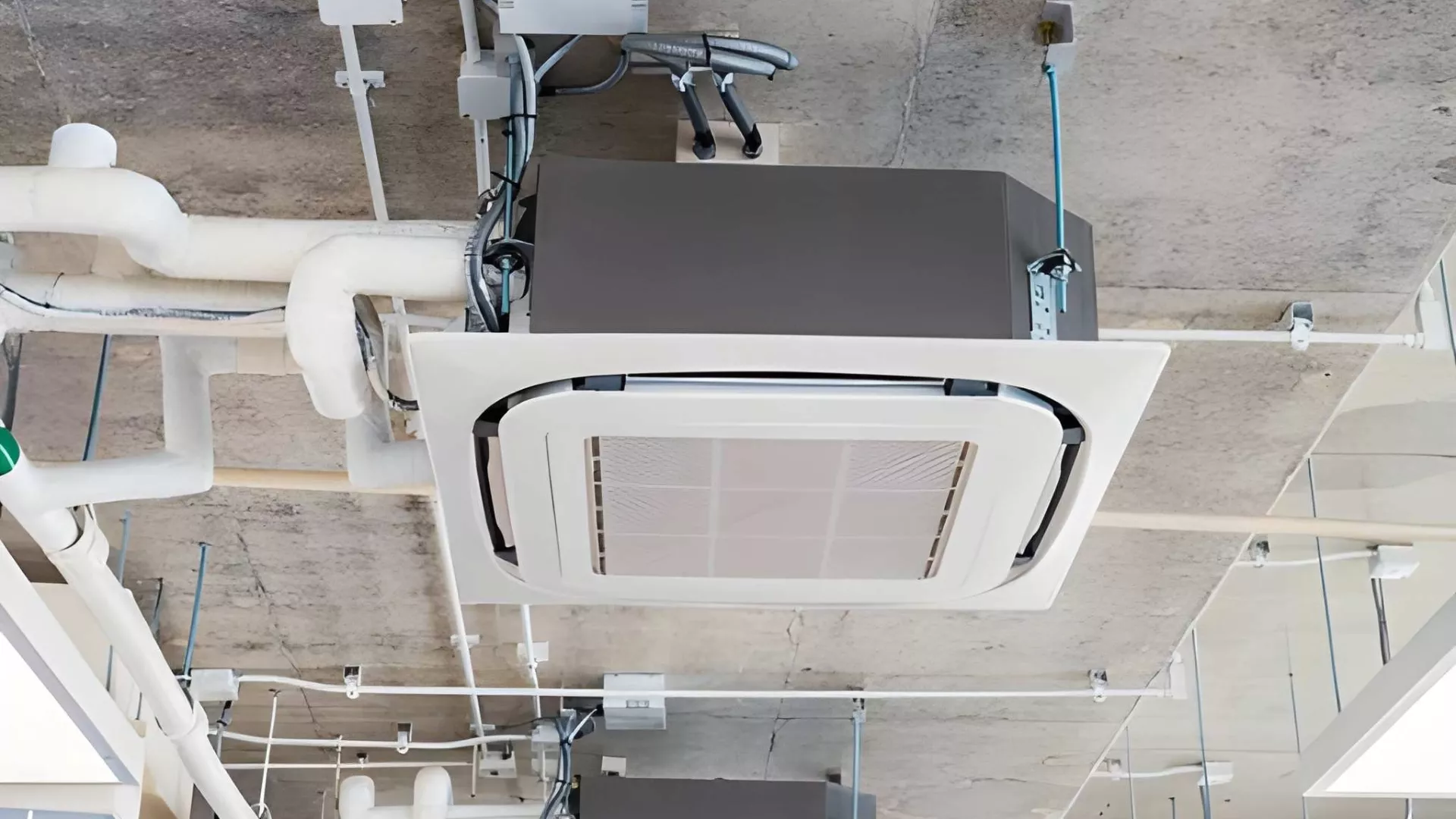
⚡ Quick Answer: 2-Pipe vs 4-Pipe Fan Coil at a Glance
2-Pipe Fan Coil uses a single coil connected to one supply and one return pipe — switching the entire system between heating and cooling seasonally. 4-Pipe Fan Coil uses two separate coils with dedicated hot and chilled water pipes — allowing independent heating and cooling in every zone, at any time.
Who should read this? HVAC contractors, mechanical engineers, and facility managers choosing the right fan coil system for their next project.
| Feature | 2-Pipe System | 4-Pipe System |
|---|---|---|
| Piping | 1 supply + 1 return | 2 supply + 2 return |
| Simultaneous H/C | No — seasonal mode only | Yes — zone by zone |
| Upfront Cost | 30–50% lower | Higher |
| Dehumidification | Limited | Excellent |
| North America Market Share (2024) | 38.1% | 61.9% — dominant |
What Is a 2-Pipe Fan Coil System and How Does It Work?
The Simple Definition
A 2-pipe fan coil system is the simpler of the two designs. It uses a single water coil inside each fan coil unit — connected to just one supply pipe and one return pipe. The central plant — your chiller or boiler — decides whether to send chilled water or hot water through that single pipe network. Think of it like a one-lane road. Traffic can only flow one way at a time. The whole building either cools or heats — not both simultaneously.
How a 2-Pipe System Works — Step by Step
- The central plant produces either chilled water (for cooling) or hot water (for heating) — never both at the same time.
- That water travels through a single supply pipe to every fan coil unit in the building.
- Each fan coil unit passes room air over the coil. The air is either cooled or heated depending on the current mode.
- A changeover sensor — typically a strap-on temperature sensor on the supply pipe — detects whether chilled or hot water is flowing.
- The thermostat reads the sensor signal and adjusts the valve and fan accordingly.
- Water returns to the central plant via a single return pipe to be rechilled or reheated.
Where 2-Pipe Systems Are Typically Found
2-pipe fan coil systems are most common in buildings where seasonal heating and cooling demands are predictable and rarely overlap. Typical applications include:
- Budget-driven high-rise residential buildings
- Schools and universities with clear summer/winter seasons
- Tropical climates where cooling dominates year-round
- Older commercial buildings built before 4-pipe became the standard
What Is a 4-Pipe Fan Coil System and How Does It Work?
The Simple Definition
A 4-pipe fan coil system uses two completely separate coils inside each fan coil unit — one dedicated to chilled water cooling and one dedicated to hot water heating. Each coil has its own supply and return pipe, giving the system four pipes in total per unit. Think of it like a two-lane road. Heating traffic and cooling traffic flow independently — at the same time — with no conflict.
How a 4-Pipe System Works — Step by Step
- The central plant produces chilled water and hot water simultaneously — each circulated through its own dedicated pipe network.
- Each fan coil unit receives both chilled water and hot water — available on demand at any time.
- Each coil has its own independent control valve — one for cooling, one for heating.
- The thermostat in each room sends signals to open the cooling valve, the heating valve, or neither — based on the room’s current temperature demand.
- One zone can be cooling to 22°C (72°F) while the zone next door is heating to 21°C (70°F) — completely independently.
- No changeover sensor is needed — the system is always ready to heat or cool on demand.
Where 4-Pipe Systems Are Typically Found
4-pipe fan coil systems are the preferred choice for any building where occupant comfort, zoning flexibility, and year-round performance are priorities:
- Hotels — where each guest room needs independent temperature control
- Hospitals — where different wards have vastly different thermal loads
- Mixed-use commercial offices — with variable occupancy throughout the day
- Data centers — where server rooms need constant cooling regardless of outdoor temperature
2-Pipe vs 4-Pipe Fan Coil — 7 Critical Differences Every HVAC Pro Must Know
The Full Side-by-Side Comparison
This table covers every critical difference between 2-pipe and 4-pipe fan coil systems. Use it as your go-to reference when specifying or comparing systems for any project.
| Feature | 2-Pipe System | 4-Pipe System |
|---|---|---|
| 1. Piping Configuration | 1 supply + 1 return | 2 supply + 2 return |
| 2. Simultaneous Heating/Cooling | No — building-wide mode only | Yes — zone by zone |
| 3. Changeover Sensor | Required | Not required |
| 4. Initial Piping Cost | ~30–50% less piping and valves | Higher — twice the piping |
| 5. Dehumidification | Limited | Excellent — cool and reheat simultaneously |
| 6. Flexibility | Seasonal only | Year-round, any zone, any time |
| 7. North America Market Share (2024) | 38.1% | 61.9% — USD 840 million |
The Single Most Important Difference
All seven differences matter — but the one that affects occupant comfort and energy bills the most is simultaneous heating and cooling capability. In any building where different zones have different thermal needs at the same time — a sunny south-facing office needing cooling while a shaded north-facing room needs heating — only a 4-pipe system can satisfy both without compromise.
Pros and Cons of 2-Pipe Fan Coil Units
The Real-World Trade-Offs
2-pipe fan coil systems have served buildings reliably for decades. However, understanding their genuine strengths and limitations is essential before specifying them for any modern project.
| ✅ 2-Pipe Pros | ❌ 2-Pipe Cons |
|---|---|
| 30–50% lower piping and valve installation cost | Cannot heat and cool simultaneously |
| Simpler installation — fewer components | Seasonal changeover causes shoulder-season discomfort |
| Easier and cheaper to maintain | Requires changeover sensor on every unit |
| Smaller mechanical space required | Limited dehumidification capability |
| Ideal for predictable seasonal climates | Poor zoning flexibility for mixed-load buildings |
The Shoulder Season Problem
The most common real-world complaint about 2-pipe systems is shoulder season discomfort. In spring and autumn, outdoor temperatures fluctuate — some rooms need cooling while others need heating on the same day. Because the entire 2-pipe system runs in one mode at a time, occupants in the wrong mode simply have to wait. This leads to comfort complaints, wasted energy, and frustrated building managers.
✅ 2-Pipe Best Suited For:
- Tropical or arid climates with cooling-dominant loads year-round
- Budget-driven high-rise residential projects
- Schools and universities with clear seasonal demand patterns
- Buildings where first cost is the absolute top priority
Pros and Cons of 4-Pipe Fan Coil Units
Why 4-Pipe Dominates Modern Projects
With 61.9% of the North American fan coil market in 2024, 4-pipe systems have clearly become the preferred choice for modern commercial construction. The reasons go beyond just technical capability — they deliver measurable improvements in comfort, energy performance, and long-term building value.
| ✅ 4-Pipe Pros | ❌ 4-Pipe Cons |
|---|---|
| Full zone independence — heat and cool simultaneously | 30–50% higher upfront piping and installation cost |
| No seasonal changeover — always ready on demand | More complex plumbing — requires more mechanical space |
| Superior dehumidification — cool and reheat simultaneously | Slightly higher maintenance on additional valves |
| 10–25% lower annual utility bills vs 2-pipe in mixed climates | Requires more skilled commissioning |
| Future-proof — meets green building and ASHRAE standards | Higher complexity for small or simple installations |
The Dehumidification Advantage
One of the most underappreciated advantages of 4-pipe systems is their superior dehumidification capability. Because the cooling coil and heating coil operate independently, the system can simultaneously cool incoming air to remove moisture — then reheat it to the desired room temperature. This process maintains both thermal comfort and indoor air quality at the same time. In humid climates or buildings with strict IAQ requirements — like hospitals and hotels — this capability is invaluable.
✅ 4-Pipe Best Suited For:
- Hotels — individual guest room temperature control at any time of year
- Hospitals — strict IAQ and simultaneous mixed-load zones
- Mixed-use commercial offices with variable daily occupancy
- Any project prioritizing long-term energy efficiency and occupant comfort
Cost Comparison — Installation, Maintenance and 10-Year Lifecycle Savings
Upfront Cost — Where 2-Pipe Wins
There is no question that 2-pipe systems cost significantly less to install. With roughly half the piping, fewer valves, and simpler controls, the upfront savings are real and substantial. For budget-driven projects or developments where first cost determines viability, this advantage is decisive.
- Piping and valve savings: 30–50% less than 4-pipe installations
- Fewer control components: One valve per unit vs two valves per unit
- Faster installation: Less pipework means shorter commissioning time
Lifecycle Cost — Where 4-Pipe Wins
Over a 10-year period, the financial picture shifts significantly in favour of 4-pipe systems — particularly in commercial buildings with variable loads. Properties that have converted from older 2-pipe systems to modern 4-pipe configurations consistently report measurable savings.
| Cost Category | 2-Pipe System | 4-Pipe System |
|---|---|---|
| Upfront Installation | Lower — 30–50% less piping | Higher — twice the piping |
| Annual Energy Cost | Higher in mixed climates | 10–25% lower annually |
| Maintenance Cost | Lower — fewer components | Slightly higher — more valves |
| Break-Even Point | N/A | 3–7 years in most commercial projects |
| 10-Year Total Cost | Higher in variable-load buildings | Lower overall — energy savings offset first cost |
Energy Efficiency and Comfort — Which System Actually Saves More?
The Real-World Energy Data
When comparing 2-pipe vs 4-pipe fan coil energy efficiency, the data consistently favours 4-pipe systems in most commercial applications. The key reason is simple: 4-pipe systems eliminate the energy waste caused by seasonal changeovers and allow precise zone-by-zone control — so the system only conditions what is actually needed, when it is needed.
When 2-Pipe Can Match 4-Pipe Efficiency
It is important to be honest: in certain conditions, 2-pipe systems can perform comparably to 4-pipe on energy consumption. Specifically:
- Tropical or arid climates — where cooling dominates year-round and heating demand is minimal or absent
- Uniform-load buildings — where all zones have similar thermal demands at all times
- Simple residential high-rises — where occupant schedules are predictable and shoulder seasons are short
In these scenarios, the 2-pipe system’s simplicity becomes an efficiency advantage — fewer components means fewer points of failure and lower parasitic energy losses.
“The energy case for 4-pipe fan coil systems in commercial buildings is compelling and well-documented. The ability to simultaneously heat and cool different zones — without running the entire plant in one mode — eliminates a significant source of energy waste that 2-pipe systems simply cannot avoid in mixed climates.”
When to Choose 2-Pipe vs 4-Pipe — Best Applications by Building Type
Choose 2-Pipe When…
- Your project has a tight upfront budget and first cost is the primary constraint
- The building is in a tropical or cooling-dominant climate with minimal heating demand
- All zones have uniform, predictable thermal loads that switch seasonally
- The project is a residential high-rise where individual comfort variation is limited
- Existing 2-pipe infrastructure is already in place and a full retrofit is not justified
Choose 4-Pipe When…
- The building has mixed-use zones with different heating and cooling demands at the same time
- Occupant comfort and IAQ are non-negotiable priorities — hotels, hospitals, premium offices
- The project is in a mixed or temperate climate with significant shoulder seasons
- Long-term energy efficiency and lower utility bills are a key project objective
- The building must meet green building certifications such as LEED or WELL
🧭 Quick Decision Guide
| Building Type | Recommended System | Key Reason |
|---|---|---|
| Luxury Hotel | 4-Pipe | Individual guest room control |
| Hospital | 4-Pipe | Strict IAQ and mixed zone loads |
| School / University | 2-Pipe | Uniform seasonal loads, lower budget |
| Mixed-Use Office | 4-Pipe | Variable occupancy and zone loads |
| Tropical High-Rise Residential | 2-Pipe | Cooling-dominant, budget priority |
| Data Center Support Zones | 4-Pipe | Year-round cooling with perimeter heating |
Thermostat and Controls Selection Guide for 2-Pipe vs 4-Pipe Systems
What 2-Pipe Thermostats Need
Thermostats for 2-pipe fan coil systems require specific logic to operate correctly. Because the system switches between heating and cooling modes seasonally, the thermostat must know which mode is currently active before it opens or closes the valve. This is where the changeover sensor becomes critical.
- Changeover detection: The thermostat reads a strap-on pipe temperature sensor to determine whether chilled or hot water is flowing
- Auto-changeover logic: Automatically switches between heating and cooling output based on the sensor reading
- Single valve output: One 2-way or 3-way valve controls water flow through the single coil
- Fan speed control: Low, medium, and high fan speed outputs for comfort adjustment
What 4-Pipe Thermostats Need
Thermostats for 4-pipe fan coil systems require more sophisticated output capabilities — because they must control two completely independent valves simultaneously.
- Dual valve outputs: Separate control signals for the chilled water valve and the hot water valve
- Independent heating and cooling control: The thermostat manages both outputs without conflict
- 0–10V or on/off signals: Modulating or switching control depending on valve type
- Dead band setting: A temperature gap between heating and cooling setpoints — typically 1–2°C (2–4°F) — prevents simultaneous valve opening
Smart Thermostat Features That Benefit Both Systems
Regardless of whether your project uses 2-pipe or 4-pipe fan coils, smart thermostats unlock significant additional value for both system types:
- Occupancy sensing: Automatically sets back temperature when a room is empty — saving energy without sacrificing comfort
- Geofencing: Pre-conditions rooms before occupants arrive — ideal for hotels and serviced apartments
- Scheduling: Aligns heating and cooling with building occupancy calendars
- Modbus / BACnet / KNX integration: Connects seamlessly to any BMS for centralized monitoring and energy analytics
Industry Statistics and Market Trends 2024–2034 — The Shift Toward 4-Pipe
The North America Fan Coil Market in Numbers
The market data tells a clear story. 4-pipe fan coil systems now dominate the North American market — and the gap is widening. According to Global Market Insights’ 2025 report, the total North American fan coil unit market reached USD 1.36 billion in 2024 and is projected to grow to USD 2.17 billion by 2034 — a compound annual growth rate of 4.9%.
2024–2034 Market Data Table
| Metric | 2-Pipe Segment | 4-Pipe Segment |
|---|---|---|
| North America Market Share (2024) | 38.1% | 61.9% — USD 840 million |
| Total Market Value (2024) | USD 1.36 billion | |
| Projected Market Value (2034) | USD 2.17 billion (CAGR 4.9%) | |
| Growth Driver | Retrofit and budget projects | Green building codes, IAQ focus, smart integration |
| Outlook to 2035 | Stable but declining share | Fastest growing — gap widening |
Source: Global Market Insights (2025), multiple corroborating 2025 industry reports
What Is Driving the Shift to 4-Pipe?
Three major forces are accelerating the market shift toward 4-pipe fan coil systems across North America and globally:
- DOE efficiency rules: Tightening federal energy standards are pushing building owners toward systems that minimize energy waste — and 4-pipe’s superior zoning directly addresses this
- ASHRAE standards: Updated ASHRAE 90.1 and 62.1 requirements favour systems with better dehumidification and IAQ performance — both strengths of 4-pipe
- Smart and IoT integration: Modern BMS platforms and smart thermostats deliver their greatest value when paired with 4-pipe systems — driving specification preference toward 4-pipe in tech-forward projects
“The commercial retrofit boom and tightening energy codes are the two biggest tailwinds for 4-pipe fan coil adoption through 2034. Building owners who invested in 2-pipe systems a decade ago are now upgrading — and they are not going back. The comfort and efficiency gains are simply too significant to ignore.”
People Also Ask — 2-Pipe vs 4-Pipe Fan Coil
Your Top Questions Answered
These are the most common questions people search for when comparing 2-pipe vs 4-pipe fan coil systems. Each answer is kept short and clear for fast reference.
❓ What is the difference between 2-pipe and 4-pipe fan coil systems?
2-pipe systems use a single coil with one supply and one return pipe — switching the entire building between heating and cooling seasonally. 4-pipe systems use two separate coils with dedicated hot and chilled water pipes — allowing independent heating and cooling in every zone at any time of year.
❓ Which is better — 2-pipe or 4-pipe fan coil?
4-pipe is better for most modern commercial projects — it holds 61.9% of the North American market in 2024 due to superior flexibility, comfort, and energy efficiency. 2-pipe is better only when first cost is the absolute priority and building loads are uniform and seasonal — such as tropical high-rise residential.
❓ Can a 2-pipe system heat and cool at the same time?
No. A 2-pipe fan coil system can only operate in one mode at a time — either heating or cooling — for the entire building or zone group. This is the fundamental limitation of the single-coil, single-pipe design. Only a 4-pipe system can heat one zone while simultaneously cooling another.
❓ Do I need a changeover sensor for a 2-pipe fan coil?
Yes — always. A changeover sensor (typically a strap-on pipe temperature sensor) tells the thermostat whether chilled water or hot water is currently flowing through the supply pipe. Without it, the thermostat cannot determine the correct operating mode and may open the valve at the wrong time — causing comfort and energy problems.
❓ How much more expensive is 4-pipe than 2-pipe?
Upfront: 4-pipe typically costs 30–50% more on piping and installation. Long-term: 4-pipe delivers 10–25% lower annual energy bills in mixed-climate commercial buildings. The typical break-even point is 3–7 years — after which 4-pipe continues delivering savings for the life of the building.
❓ Are 4-pipe systems more energy efficient?
Yes — in most commercial applications. 4-pipe systems eliminate energy waste from seasonal changeovers, enable precise zone-by-zone control, and provide superior dehumidification. In very stable or tropical climates with uniform loads, 2-pipe can be comparable. However, in mixed climates and variable-load buildings, 4-pipe consistently delivers lower annual utility bills.
Final Verdict — Which Fan Coil System Delivers Better ROI?
The Bottom Line on 2-Pipe vs 4-Pipe
After reviewing all the technical data, cost analysis, and market statistics, the verdict is clear for most modern projects. 4-pipe fan coil systems deliver superior ROI in the majority of commercial buildings — thanks to better energy efficiency, superior comfort, and growing alignment with green building codes and ASHRAE standards. The higher upfront cost pays back within 3–7 years in most mixed-climate applications.
That said, 2-pipe systems are far from obsolete. They remain the smart, practical choice for budget-driven projects, tropical climates, and buildings where uniform seasonal loads make the additional complexity of 4-pipe unnecessary and unjustifiable.
Final Verdict Summary Table
| Category | Winner | Why |
|---|---|---|
| Upfront Installation Cost | 🏆 2-Pipe | 30–50% lower piping and valve cost |
| Annual Energy Efficiency | 🏆 4-Pipe | 10–25% lower utility bills in mixed climates |
| Occupant Comfort | 🏆 4-Pipe | Zone-by-zone control, no shoulder season issues |
| Installation Simplicity | 🏆 2-Pipe | Fewer components, faster commissioning |
| Dehumidification | 🏆 4-Pipe | Simultaneous cool and reheat capability |
| Market Momentum | 🏆 4-Pipe | 61.9% NA market share and growing |
| Budget Retrofits | 🏆 2-Pipe | Lower first cost, uses existing infrastructure |
| 10-Year Lifecycle ROI | 🏆 4-Pipe | Energy savings offset higher first cost within 3–7 years |
Conclusion: Choose the Right Fan Coil System — and the Right Thermostat to Control It
What We Have Learned
Choosing between a 2-pipe and 4-pipe fan coil system is one of the most consequential decisions in any HVAC project. Get it right and you deliver a building that is comfortable, efficient, and future-proof. To summarize everything covered in this guide:
- 2-pipe wins on upfront cost, installation simplicity, and suitability for uniform seasonal loads
- 4-pipe wins on energy efficiency, occupant comfort, dehumidification, and long-term ROI
- 4-pipe dominates the North American market at 61.9% share — and the gap is growing
- The break-even point for 4-pipe is typically 3–7 years — after that, it pays you back every month
- The right smart thermostat — configured correctly for your pipe system — unlocks an additional 10–20% in energy savings on top of your base system performance
